
Why generic SEO content is losing value, what AI changes about authority, and what AEC firms should create instead.
For years, construction marketing teams were told to publish more content.
Write the blog post about how to choose a contractor. Create the guide to remodeling costs. Explain the commercial construction process. Define value engineering. Answer every basic question a prospective client might type into Google.
That strategy was not wrong. For a long time, it worked.
Search engines rewarded companies that consistently published useful, keyword-focused content. If your firm had a better article about “how much does a kitchen remodel cost” or “what is design-build construction,” you had a reasonable chance of earning search visibility, driving traffic, and introducing new prospects to your brand.
Artificial intelligence has changed the value of that content.
As I discussed in my previous article, AI Didn’t Kill Content Marketing. It Killed Lazy Content Marketing, the competitive advantage hasn’t shifted away from content itself—it has shifted away from publishing generic information and toward demonstrating genuine expertise.
AI tools can now summarize broad informational topics instantly. They can explain what value engineering is, list the steps in a commercial construction project, and generate a generic guide to choosing a contractor in seconds. That means the content many firms spent years producing is becoming easier to create, easier to copy, and less differentiated than ever.
This does not mean content marketing is dead.
It means commodity content is.
What is commodity content?
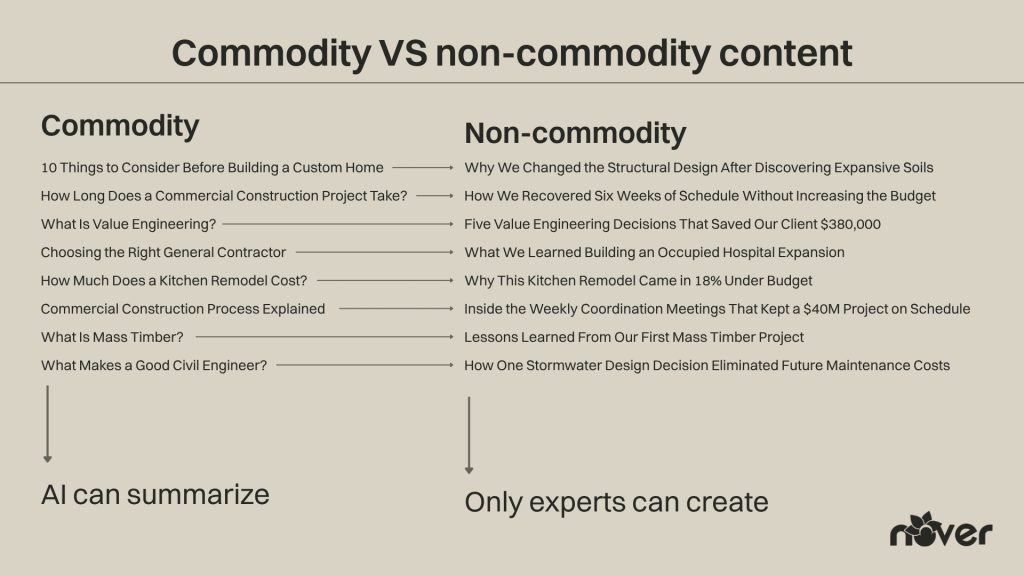
Commodity content is content that summarizes information already widely available.
It is not necessarily inaccurate. It may even be helpful. The problem is that it does not contain any meaningful insight that another firm, freelancer, offshore writer, or AI tool could not produce with minimal context.
In construction marketing, commodity content often looks like:
- “10 Things to Consider Before Building a Custom Home”
- “How Long Does a Commercial Construction Project Take?”
- “What Is Value Engineering?”
- “Choosing the Right General Contractor”
- “How Much Does a Kitchen Remodel Cost?”
- “The Commercial Construction Process Explained”
- “What Is Mass Timber?”
- “What Makes a Good Civil Engineer?”
Again, none of these topics are inherently bad. Prospective clients do ask these questions, and firms still need clear educational content on their websites. The issue is that these topics are no longer a meaningful competitive advantage on their own.
They explain what everyone already knows.
AI is very good at that.
Why commodity content used to work
Commodity content worked because search behavior was fragmented and search engines needed web pages to answer basic questions.
If a homeowner wanted to understand the cost of a bathroom remodel, they went to Google. If a developer wanted to understand the difference between construction management and design-build, they went to Google. If a facilities manager wanted to understand what to expect during an occupied renovation, they went to Google.
The firm that published the clearest, most optimized answer had an opportunity to be discovered.
That model rewarded content volume. The more questions you answered, the more search opportunities you created. The more blog posts you published, the more chances you had to rank. Over time, many marketing strategies became built around producing as much educational content as possible.
For industries with high search volume and short sales cycles, that approach made sense.
But AEC is different.
Construction decisions are high-consideration, high-trust, and often high-dollar. A custom home, commercial renovation, civil engineering project, or multifamily development is not purchased because someone read one generic blog post. These decisions involve risk, reputation, expertise, relationships, and proof.
Commodity content may help someone understand a concept.
It rarely proves that your firm is the right one to hire.
What AI changed
AI did not make educational content irrelevant. It changed the standard for what educational content needs to accomplish.
When a prospective client asks ChatGPT, Perplexity, Gemini, or Google’s AI Overviews a broad question, AI can often provide a usable answer without requiring that person to click through to a website. That is especially true for generic questions with well-established answers.
What is value engineering?
How does design-build work?
What questions should I ask a contractor?
How long does construction take?
These are exactly the kinds of questions AI is designed to synthesize. Large language models are trained on enormous volumes of existing information, which means they are highly effective at summarizing topics that have already been written about thousands of times.
That is the weakness of commodity content.
If your article only reorganizes information that already exists across the internet, AI can do the same thing faster.
Research presented during the Writesonic AI Era Webinar reinforces this shift. Following a single ChatGPT model update, the percentage of citations pointing to a company’s own website fell from 5.2% to just 4.3%, while citations to third-party sources increased significantly. The implication is clear: simply publishing another article on your own website is becoming a weaker signal of authority than creating expertise that others reference and discuss.
We explored these broader changes in AI authority, citations, and third-party trust signals in AI Didn’t Kill Content Marketing. It Killed Lazy Content Marketing. This article focuses on one practical implication of those changes: why commodity content is becoming a weaker competitive advantage.
The competitive advantage shifts away from publishing basic information and toward documenting original experience.
During the webinar, Ross Simmonds made an observation that has stuck with me. In mature industries, AI increasingly rewards non-commodity content—content that documents original experience rather than summarizing existing knowledge. I believe construction is one of the clearest examples of this principle because there is already an enormous amount of educational content explaining what contractors, engineers, and architects do. The firms that stand out will increasingly be the ones explaining how they think, not simply what they do.
Commodity content versus expertise content
The difference between commodity content and expertise content is the source of the knowledge.
Commodity content starts with a topic.
Expertise content starts with experience.
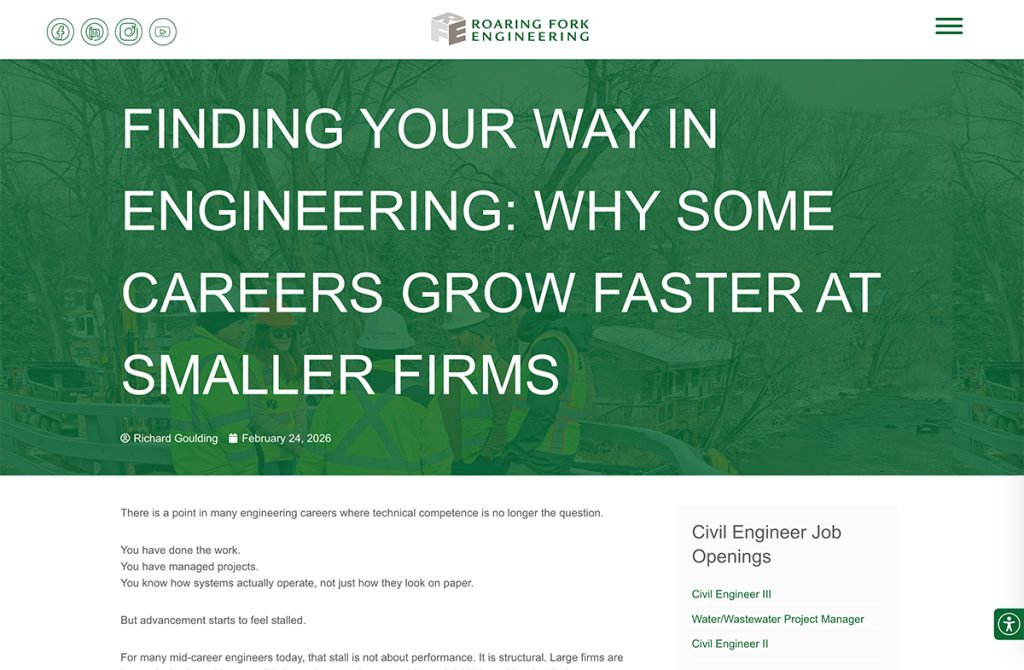
For example, a commodity article might be titled, “What Is Value Engineering?” An expertise-driven article might be titled, “Five Value Engineering Decisions That Saved Our Client $380,000 Without Changing the Design Intent.”
A commodity article might explain, “How Long Does a Commercial Construction Project Take?” An expertise-driven article might explain, “How We Recovered Six Weeks of Schedule Without Increasing the Budget.”
A commodity article might summarize, “10 Things to Consider Before Building a Custom Home.” An expertise-driven article might document, “Why We Changed the Structural Design of This Aspen Home After Discovering Expansive Soils.”
The second version of each article is more difficult to create because it requires real project knowledge. It requires someone to understand what happened, why it happened, what decisions were made, what tradeoffs were considered, and what the outcome was.
That is exactly why it is more valuable.
AI can explain the concept.
It cannot invent your lived experience.
Why construction companies have an unexpected advantage
Ironically, I believe this shift favors architecture, engineering, and construction firms. Unlike industries that depend on producing large volumes of marketing content, AEC companies generate original experience every single day simply by doing the work. Every unforeseen site condition, every value engineering decision, every coordination meeting, every client conversation, and every design revision creates knowledge that didn’t exist before the project began.
Construction companies often underestimate just how valuable that knowledge is. A project manager solves a sequencing issue. A superintendent catches a field conflict before it becomes expensive. An engineer identifies a better solution after reviewing site constraints. A designer adjusts a material selection because of availability, durability, or budget. A client asks a question that reveals a common misconception.
To the people inside the project, those moments may feel routine. They’re simply part of doing the job. To a prospective client, however, they’re proof. They demonstrate how your team thinks, how you solve problems, how you manage risk, how you communicate, and ultimately how you protect the outcome of a project. AI can summarize thousands of articles about value engineering or project management, but it can’t invent the moment your team avoided a costly delay, solved an unexpected challenge, or found a better solution for a client. It can only learn from the firms willing to document those experiences.
That is the opportunity most AEC firms are missing. They’re trying to create marketing content from a blank page when their most valuable content is already embedded inside the projects they complete every day.
The new content question
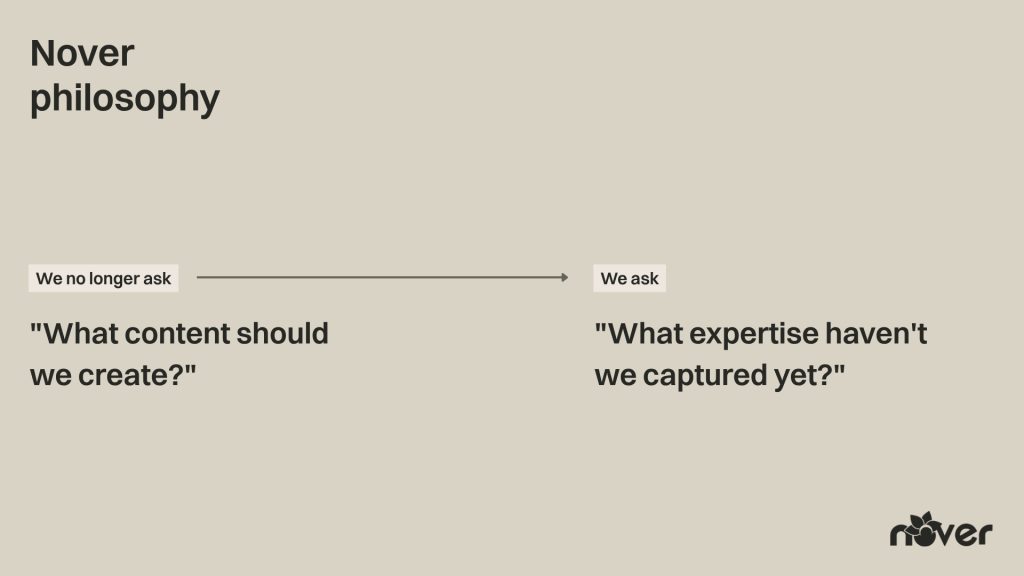
The old content question was:
“What should we write about?”
The better question is:
“What expertise have we not captured yet?”
That shift matters because it changes where content strategy begins. Instead of starting with a keyword list, it starts with the firm’s actual experience. Instead of asking what AI can summarize, it asks what only your team could know.
That does not mean keyword research disappears. Search behavior still matters. Prospects still ask questions, and content still needs to be discoverable. But keyword research should inform the article, not define the value of the article.
The strongest construction content now sits at the intersection of three things:
- What your ideal clients care about
- What your team has genuinely experienced
- What your competitors cannot easily replicate
Commodity content usually answers only the first.
Expertise content answers all three.
So what should construction companies do instead?
If commodity content is losing value, the obvious question becomes: what should replace it?
The answer isn’t simply to publish less. It’s to become dramatically better at capturing the expertise your team creates every day.
Every completed project represents hundreds of decisions, lessons learned, client conversations, technical challenges, and creative solutions. Unfortunately, most of that knowledge disappears the moment the project wraps up. A few professional photographs are taken, a short project description is written, and everyone moves on to the next job.
That’s a tremendous missed opportunity.
The firms that will build authority over the next decade won’t necessarily be the firms producing the most content. They’ll be the firms with a disciplined process for documenting project knowledge before it’s forgotten and systematically transforming that expertise into case studies, videos, educational articles, project stories, award submissions, podcast discussions, PR opportunities, and thought leadership.
In other words, they’ll stop treating marketing as content creation and start treating it as expertise preservation.
At Nover, that realization completely changed how we approach construction marketing. Instead of asking, “What content should we create?” we now begin with a different question:
What expertise haven’t we captured yet?
That single question became the foundation for a repeatable framework we now use to help clients preserve, organize, distribute, and compound the expertise created on every completed project.
We’ll break that framework down in the next article.
For now, the takeaway is simple:
The future of construction marketing doesn’t belong to the companies publishing the most content.
It belongs to the companies preserving the most expertise.
