
How AI search is reshaping authority, why AEC firms have an unexpected advantage, and what construction marketers should do next.
For more than a decade, content marketing followed a relatively simple formula.
Publish more blog posts. Target more keywords. Build more backlinks. Post consistently on social media. If your competitors published twice a month, publish weekly. If they targeted fifty keywords, target one hundred. The firms willing to create more content generally outperformed those that didn’t.
Artificial intelligence has fundamentally changed that equation.
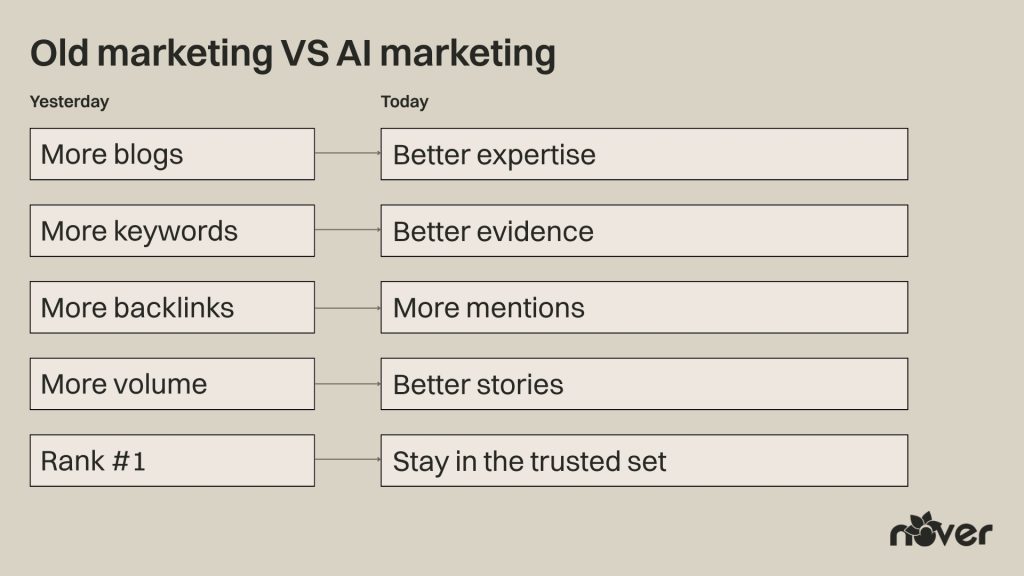
The arrival of ChatGPT, Google’s AI Overviews, Perplexity, Gemini, and Microsoft’s Copilot has caused many marketers to ask the wrong question:
“Is SEO dead?”
It isn’t.
The better question is:
“What kind of content deserves to exist when AI can create average content in seconds?”
That distinction is going to define the next decade of marketing.
The misconception about AI content
One of the biggest misconceptions I’ve seen over the past year is that AI makes content easier. In one sense, that’s absolutely true. AI can generate words faster than any marketing team ever could. It can write blog posts, summarize research, draft social captions, and produce an endless stream of articles in seconds.
What AI has made easier, however, is the production of average content.
If your content strategy depended on publishing another article titled “10 Things to Consider Before Hiring a General Contractor,” AI can now generate that article in fifteen seconds. So can your competitors. So can your prospects. The barrier to producing generic content has effectively disappeared, and with it, much of the competitive advantage that came from simply publishing more often.
That’s why I don’t believe AI killed content marketing. I believe it killed lazy content marketing.
For years, many businesses won by creating content that reorganized information already available on the internet. They combined existing ideas into new blog posts, optimized them for search engines, and gradually built traffic through consistency and volume. That strategy worked because search engines rewarded comprehensive coverage of common topics.
Large language models change the equation. They were trained on much of that same information and are exceptionally good at summarizing it, reorganizing it, and explaining it. If your content contributes nothing beyond what AI already knows, it becomes increasingly difficult to justify why someone should visit your website instead of accepting the answer generated directly within ChatGPT or Google’s AI Overview.
The internet doesn’t need another generic article.
It needs evidence—real projects, original insights, measurable results, and expertise that could only come from experience.
The data tells an interesting story
Recently, I attended the Writesonic AI Era Webinar, which featured research into how today’s leading AI models choose the sources they reference. One of the featured speakers, Ross Simmonds, has spent years studying content distribution and off-page authority, and many of the findings challenged long-held assumptions about SEO.
Several statistics stood out.
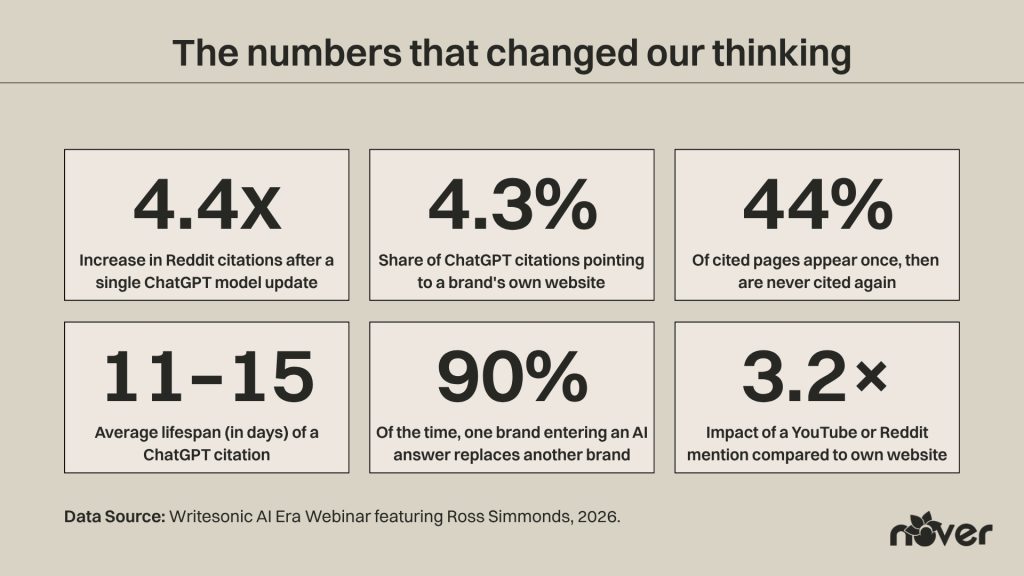
Following a single ChatGPT model update in May, Reddit citations increased by 4.4x. At the same time, the percentage of ChatGPT citations that referenced a company’s own website fell from 5.2% to 4.3%.
Think about what those numbers actually mean.
For years, marketers have treated their website as the center of their digital universe. Every blog post, landing page, and SEO initiative was designed to strengthen the authority of a single destination. AI is increasingly treating your website differently. Rather than viewing it as the definitive source of truth, it evaluates it alongside a much broader ecosystem of signals from across the web.
Another statistic from the webinar reinforced just how dynamic that ecosystem has become. Nearly 44% of cited pages appeared only once before disappearing entirely, while the average citation remained visible for only 11 to 15 days before being replaced. AI visibility, in other words, isn’t something you earn once and keep indefinitely. It’s something that must be continually reinforced as models update, new content is published, and fresh sources emerge.
Perhaps the most important insight, however, wasn’t about how frequently citations change. It was about how AI determines authority in the first place.
Your website is no longer the strongest signal
One of the webinar’s most surprising conclusions was that your own website is no longer the strongest place to establish authority.
In fact, trusted third-party mentions consistently outperformed self-published content.
According to the research presented:
- A YouTube mention carried roughly 3.2 times the influence of publishing the same information on your own website.
- Reddit mentions performed similarly.
- Gartner citations were approximately 3.2 times stronger.
- G2 listings were approximately 2.3 times stronger.
- LinkedIn mentions outperformed publishing solely on your own website.
That doesn’t mean websites no longer matter. They absolutely do. Your website remains your digital headquarters—it’s where prospective clients evaluate your work, learn about your services, explore your portfolio, and ultimately decide whether to contact you. What has changed isn’t the importance of your website, but the way authority is established.
Increasingly, AI looks for corroboration. Rather than relying solely on what a company says about itself, it evaluates whether that expertise is consistently reflected across multiple trusted sources. That’s a profound shift from traditional SEO, where so much emphasis was placed on optimizing pages within your own domain.
Today, authority is becoming increasingly distributed.
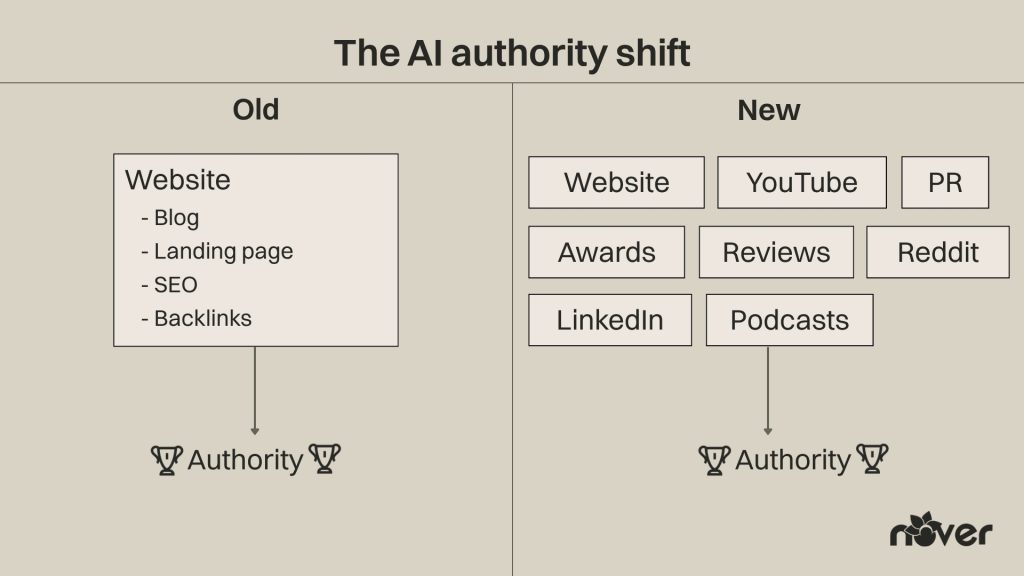
Awards, industry publications, podcast appearances, YouTube videos, client reviews, original research, and mentions from respected organizations all contribute to the broader digital footprint AI uses to evaluate credibility. Perhaps most importantly, AI is looking for evidence that other people are talking about your company—not just that you’re talking about yourself.
The opportunity hiding in plain sight
At first glance, this sounds like bad news for architecture, engineering, and construction firms. I believe it’s exactly the opposite. In fact, I think AEC firms may be better positioned than almost any other industry to benefit from this shift because the qualities AI increasingly rewards are the same qualities that have always driven successful project-based businesses.
Construction has never been a short-form purchasing decision. A homeowner doesn’t hire a custom home builder because of a single blog post. A hospital doesn’t award a multimillion-dollar project because of one LinkedIn update, and a commercial developer doesn’t select an engineering firm simply because it ranked first for a keyword. Long before AI existed, AEC firms won work by demonstrating trust, reputation, technical expertise, and a proven history of delivering successful projects.
The challenge has never been that construction companies lack expertise. The challenge is that they rarely capture it.
Every completed project represents months—or sometimes years—of problem-solving, technical decisions, client collaboration, value engineering, scheduling challenges, innovation, and lessons learned. Yet once the ribbon is cut, most of that knowledge quietly disappears. A few professional photographs are uploaded to the website, a short project description is written, perhaps a social media post announces the completion, and then everyone moves on to the next job.
Thousands of hours of experience remain locked in the minds of project managers, superintendents, engineers, architects, and owners. Very little of it is ever documented, shared, or transformed into assets that continue building authority after the project is complete.
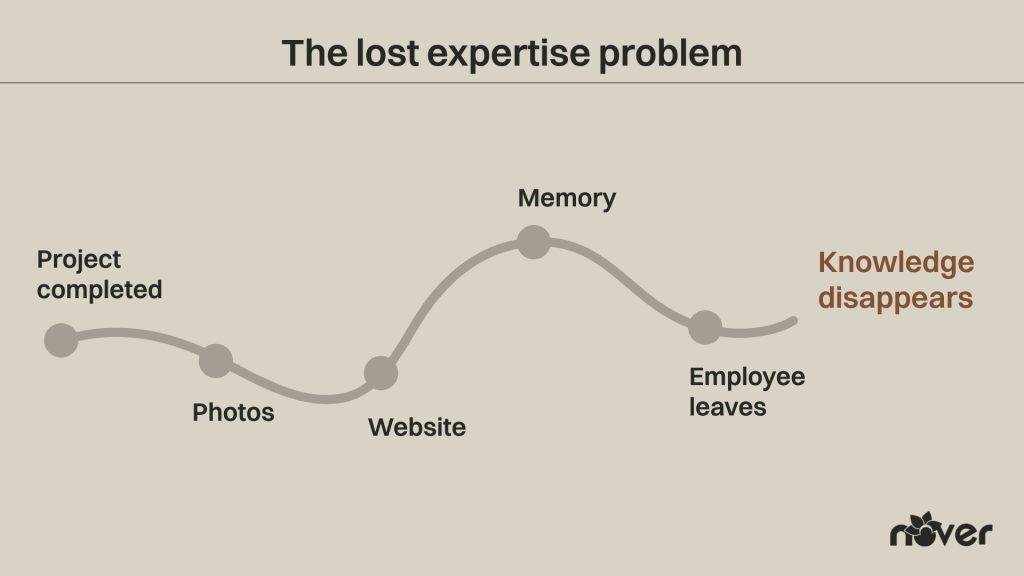
I believe that’s where the greatest opportunity for AEC marketing now exists—not in creating more content, but in preserving and distributing the expertise companies have already earned.
AEC has a competitive advantage—if it chooses to use It
One observation from the Writesonic webinar stayed with me long after it ended.
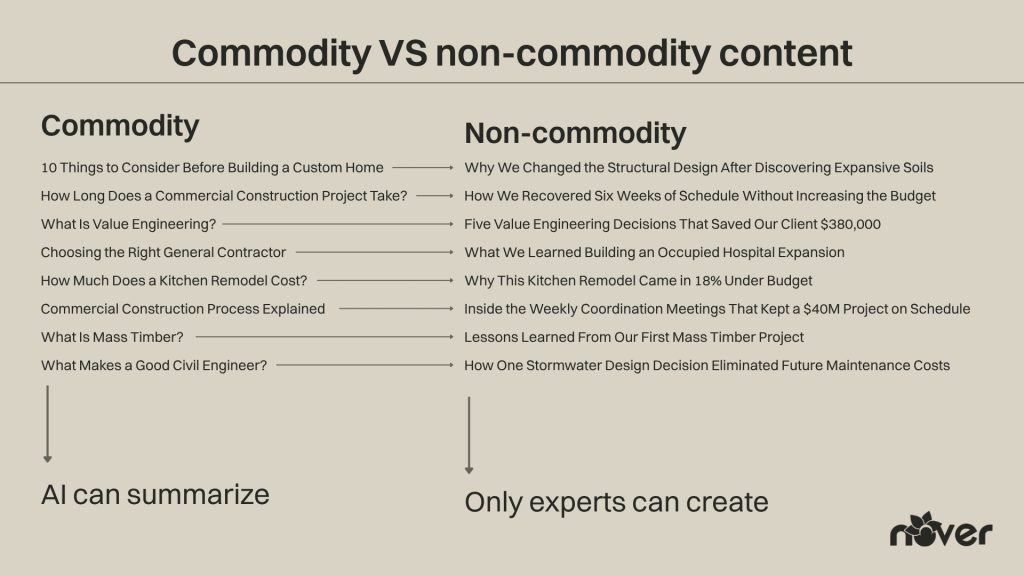
Ross Simmonds argued that Google and AI systems increasingly favor non-commodity content. Commodity content still has a place—particularly in emerging industries where little information exists—but in mature industries, differentiation comes from publishing information that only genuine experience can produce.
That distinction is incredibly important for architecture, engineering, and construction.
AEC is not a new industry.
It is one of the oldest industries in the world.
There are already millions of articles explaining what a general contractor does, how to choose a structural engineer, what to expect during a remodel, or the ten things to know before building a custom home.
Those articles aren’t necessarily bad.
They’re simply no longer enough.
When AI can generate those answers instantly—and often answer the question directly without someone ever visiting your website—the competitive advantage shifts elsewhere.
It shifts toward experience.
The content AI can’t invent
Consider two different articles.
The first is titled, “10 Things to Consider Before Building a Custom Home.” The second is titled, “Why We Changed the Structural Design of This Aspen Home After Discovering Unexpected Soil Conditions.”
The difference between those two articles isn’t just the headline. It’s the source of the knowledge. The first summarizes information that already exists across thousands of websites. The second documents a real decision made during a real project—something that could only be written by the team that experienced it firsthand.
That’s the difference between commodity content and expertise.
AI is becoming exceptionally good at producing the first type of content because it’s designed to synthesize existing information. What it can’t manufacture is firsthand experience, original decision-making, or the nuanced lessons that come from solving complex problems on actual projects. Those are the insights that establish authority, differentiate firms, and increasingly give both prospective clients and AI systems a reason to trust your expertise.
Construction companies are sitting on a gold mine
One of the biggest myths in AEC marketing is that firms don’t have enough content to create. I believe the opposite is true. Most architecture, engineering, and construction companies are sitting on hundreds of stories they never tell because they don’t recognize them as marketing opportunities.
Every completed project is filled with decisions that prospective clients would find genuinely interesting. Why was a material changed halfway through construction? How did the team resolve an unexpected scheduling conflict? What design compromise ultimately produced a better outcome? What lessons from this project changed how the company approaches future work? These aren’t marketing stories—they’re project stories. Marketing simply gives them a platform.
The irony is that many firms spend months trying to brainstorm blog topics while standing on years of untapped expertise. The answers their prospective clients are searching for often already exist inside completed projects—they’ve just never been documented.
The long sales cycle challenge
This opportunity becomes even more significant because of how construction businesses actually operate. Unlike SaaS companies that may onboard thousands of customers every month or e-commerce businesses that process hundreds of orders each day, AEC firms complete relatively few projects each year. A custom home builder may finish twenty homes annually. A commercial contractor may complete only a handful of major projects, while a civil engineering firm may work on just a few landmark infrastructure projects.
Those businesses don’t have the luxury of generating an endless stream of customer stories. Every project has to work harder.
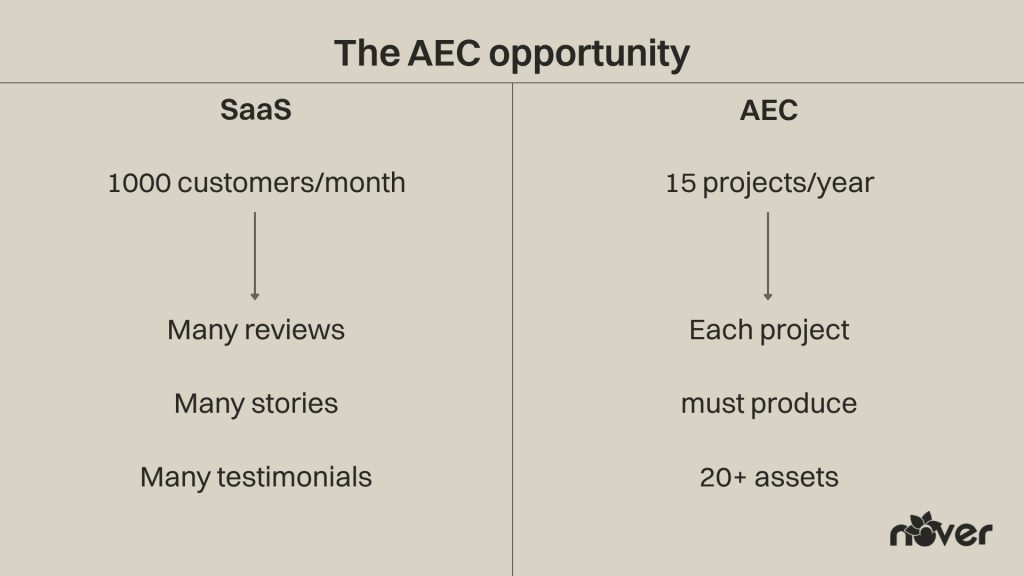
It has to establish trust, demonstrate expertise, support future sales conversations, and continue building authority long after construction is complete.
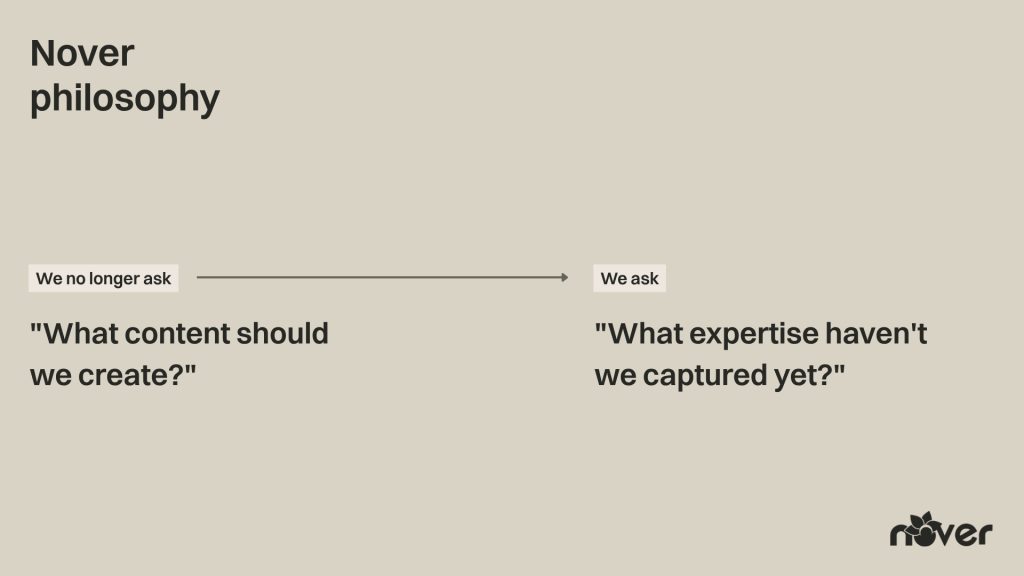
That realization completely changed how we think about marketing at Nover. Instead of asking, “What content should we create this month?” we started asking, “How much expertise can we extract from every completed project?” Those are fundamentally different questions, and they lead to fundamentally different marketing strategies.
Marketing Is no longer a volume game
For years, successful content marketing rewarded consistency and scale. Publish frequently. Stay active. Produce more than your competitors. While consistency still matters, I don’t believe volume alone creates authority anymore.
AI has fundamentally raised the standard for what deserves to be published. Generic content becomes less valuable because AI can already generate it. Original expertise, firsthand experience, measurable results, and thoughtful analysis become dramatically more valuable because they can’t be manufactured from existing information alone.
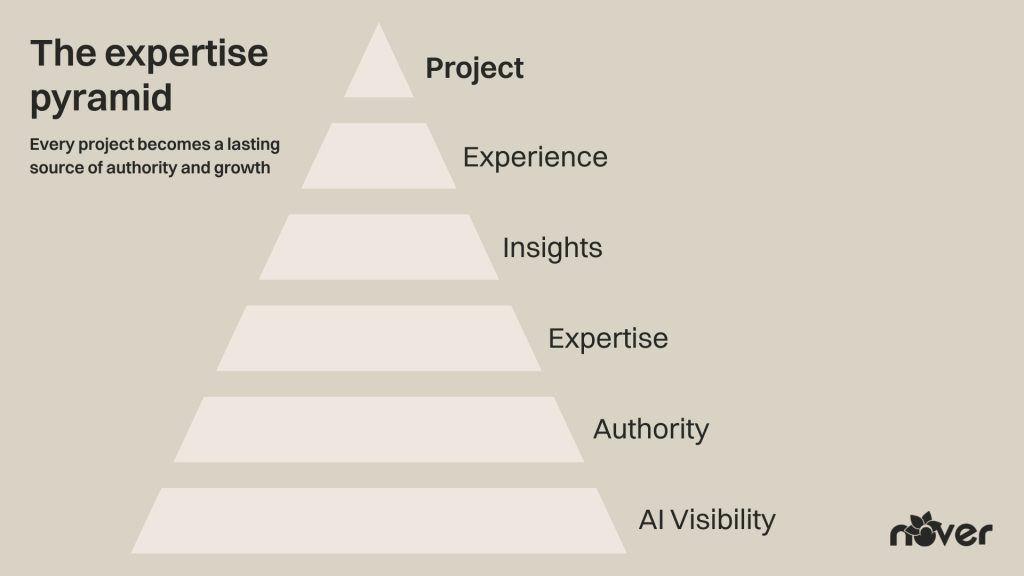
I believe one of the biggest mistakes construction marketers will make over the next several years is assuming AI simply requires them to produce more content. In reality, it requires them to produce better evidence. That’s encouraging news for AEC firms because their competitive advantage has never been the number of articles they publish—it’s the depth of expertise they gain from every project they complete.
Expertise is already there
One of my favorite conversations with new clients happens when we begin discussing completed projects. We’ll ask a project manager what made a particular project unique, and the initial response is often something like, “Nothing really. It was a pretty standard project.”
Then we start asking better questions.
What unexpected issues came up? Why did you choose that solution instead of another? What almost went wrong? What would you do differently today? What surprised the client? What surprised your team?
Twenty minutes later, we have enough material for multiple articles, videos, case studies, social posts, and educational resources. The expertise was always there; no one had simply taken the time to uncover it.
That’s why I believe marketers need to stop thinking of themselves primarily as content creators. Increasingly, our role is to become investigators and translators—people who know how to ask thoughtful questions, uncover years of technical experience, and transform that knowledge into content that educates prospective clients, builds trust, and demonstrates genuine authority. The expertise already exists within the organization. Our responsibility is making sure it doesn’t disappear when the project ends.
From content creation to expertise extraction
That shift in thinking ultimately led us to develop TEEM™—The Expertise Extraction Method™. We didn’t create TEEM because we wanted another proprietary framework. We created it because we realized our clients’ greatest marketing asset wasn’t their website, logo, or even their project photography. It was the conversations that happened after a project was complete.
Those conversations are filled with the kinds of insights that AI can’t manufacture: the difficult decisions, unexpected challenges, lessons learned, client relationships, creative problem-solving, and technical expertise that only the people who completed the project can share. They represent exactly the type of original, experience-driven content that AI increasingly rewards and the type of evidence prospective clients have always trusted.
The future of construction marketing isn’t about producing more content. It’s about preserving more expertise.
In the next article in this series, we’ll explore why your last completed project may be the single most valuable marketing asset your company already owns—and how one completed project can generate months of authoritative content without inventing a single new idea.
The future belongs to companies willing to teach
One of the most interesting findings from the Writesonic webinar wasn’t actually about citations—it was about competition. According to the research, roughly 90% of the time one brand enters an AI-generated answer, another brand disappears. AI isn’t creating an unlimited number of positions for companies to occupy. It’s continuously evaluating which brands deserve to be included and replacing one source with another as new evidence emerges.
That fundamentally changes how we should think about marketing. For years, marketers chased rankings, believing the objective was to become the number one result for a given keyword. AI doesn’t work that way. Research presented during the webinar showed that seven to nine different brands frequently rotate through the top position, and ChatGPT’s number one recommendation changes nearly 50% of the time when the same question is asked repeatedly.
The objective is no longer to own a single position forever. The objective is to consistently remain part of the trusted conversation. That requires something very different than publishing another keyword-driven article. It requires becoming a company worth referencing—one that continually demonstrates expertise through projects, research, industry involvement, client success, and contributions that extend well beyond its own website.
The companies that thrive over the next decade won’t necessarily be the ones with the largest marketing budgets or the biggest content teams. They’ll be the organizations that consistently document their experience, share what they’ve learned, and contribute something genuinely valuable to their industry. They’ll treat every completed project as an opportunity to teach rather than simply another project to showcase.
For architecture, engineering, and construction firms, I believe that’s an encouraging shift.
Our industry has never lacked expertise. It has simply lacked a repeatable way to capture and distribute it. AI isn’t asking construction companies to become better marketers; it’s asking them to become better teachers. The firms willing to explain how they solved difficult problems, why they made certain decisions, and what they learned along the way will build a body of evidence that no amount of generic content can replicate.
At Nover, this realization fundamentally changed how we think about marketing. Instead of starting with the question, “What content should we create?” we now begin with a different question:
What expertise haven’t we captured yet?
That single shift has influenced everything from how we interview clients to how we develop case studies, thought leadership, videos, PR, awards, and educational content. It ultimately led us to create TEEM™—The Expertise Extraction Method™—our internal framework for systematically capturing, preserving, and distributing the expertise created on every completed project.
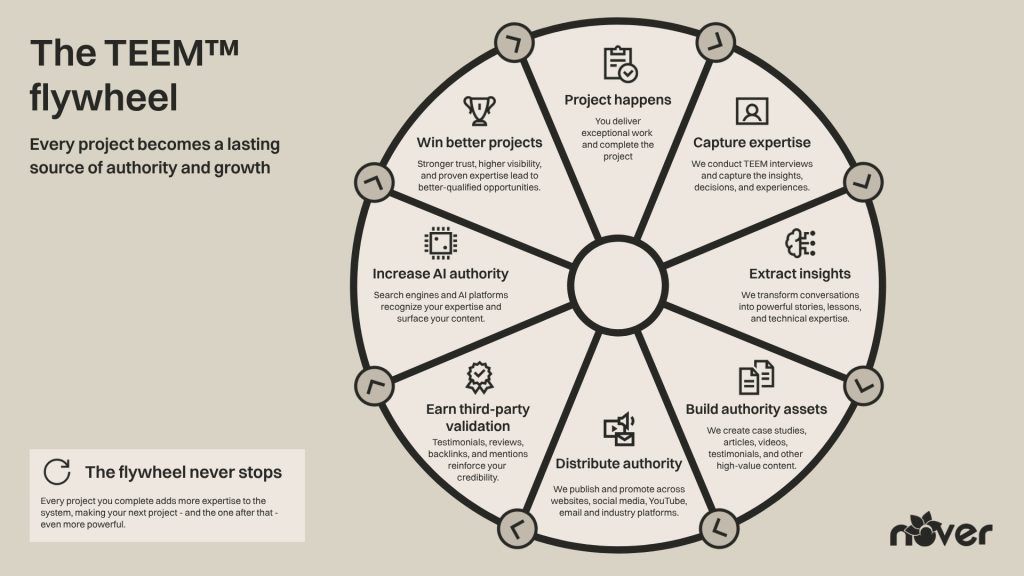
We’ll explore that process in the next article.
For now, the takeaway is much simpler.
The competitive advantage has shifted.
Not from SEO to AI.
Not from websites to social media.
From publishing information to proving expertise.
Construction companies already possess that expertise. The opportunity isn’t creating something new. It’s making sure the world—and increasingly AI—can see what you’ve known all along.
Projects are temporary.
Expertise shouldn’t be.
About the Research
Many of the statistics referenced in this article come from the Writesonic AI Era Webinar, featuring research into AI search behavior and presentations by Ross Simmonds on content distribution and off-page authority. The examples and opinions throughout this article represent Nover’s interpretation of that research through the lens of architecture, engineering, and construction marketing.
What’s Next
This article is the first in our AI & AEC Marketing series.
Next: The Death of Commodity Content in Construction Marketing, where we’ll explore why generic SEO content is rapidly losing value, how AI distinguishes commodity content from original expertise, and what construction companies should be creating instead.
