
Meta ads for custom home builders can work in some contexts, but they are often misunderstood.
For high-ticket residential design-build firms, Facebook and Instagram are usually not the channels that produce immediate, bottom-of-funnel leads for services like custom homes and whole-home remodels. The buyer journey is too long, the project value is too high, and the trust required is too significant.
This case study breaks down why a third-party pay-per-lead Meta strategy failed for the home side of an established design-build business, what the numbers revealed instead, and how historical channel performance pointed to a more effective path forward.
The client challenge
This client had been with us for more than a year.
We originally started by managing pay-per-click advertising. In recent months, the relationship expanded into a broader full-service marketing engagement that included SEO, paid Meta, display, video, and social media.
The business had two distinct divisions:
- Landscaping, which was performing very well.
- Homes, which was underperforming.
The home side of the business wanted to generate more qualified opportunities for:
- Custom homes.
- Whole-home remodels.
- Large design-build residential projects.
Because the home division was struggling, the client decided to test a third-party agency offering pay-per-lead Meta ads.
We advised against it from the beginning.
Why the pay-per-lead Meta model was a poor fit
The service was too high-consideration
Custom homes and whole-home remodels are not impulse purchases.
These are large, expensive, high-trust projects. Homeowners do not typically see a generic ad in their social feed and suddenly decide to move forward with a six-figure or seven-figure project. They research. They compare. They review portfolios. They assess whether the firm feels credible and aligned with the level of work they want.
That is why channel fit matters so much for a custom home builder.
The ads were generic
The third-party provider did not build unique ads tailored to the client’s actual work, positioning, or market.
Instead, the agency used prebuilt ad sets for categories like:
- Additions.
- Bathrooms.
- Other standardized remodeling offers.
Those campaigns were essentially duplicated into the client’s market. The ads did not meaningfully reflect the company’s actual product or the level of project it wanted to attract.
For a premium design-build brand, that is a major problem. The ad creative needs to communicate:
- Scope.
- Design quality.
- Brand credibility.
- Service specificity.
- Project fit.
These ads did not.
The traffic went to an off-site lead form
Instead of sending users to the client’s website, the campaigns routed prospects to an off-site lead generation form where they had to make selections before submitting.
That removed the context a premium residential contractor needs in order to prequalify leads.
For high-value design-build work, the website is part of the sales process. It provides:
- Project examples.
- Brand positioning.
- Trust signals.
- Service explanations.
- Visual proof of quality.
When you remove that experience, you often increase form submissions while decreasing lead quality.
That aligns with our broader philosophy as well. Our construction marketing guidance notes that Meta ads often produce higher-funnel inquiries and that sending traffic to a website is usually better for filtering out lower-quality leads than keeping users in a simplified platform form, like we did when we launched this new ADU builder to $1 million in a year.
The campaign structure prioritized volume over fit
The third-party agency required the client to launch with additions. Part of the reason was that this model tends to perform better in categories like ADUs and related lower-friction project types.
But that was not what the client wanted.
The client was looking for:
- Custom homes.
- Whole-home remodels.
- Larger right-fit residential projects.
That distinction is critical. A lead can be in-market and still be the wrong lead.
What happened during the Meta ad test
The campaigns launched at approximately:
- $150 per day.
- About $1,050 per week.
- About $4,500 over a 30-day period.
The test lasted roughly 3 weeks before the campaigns were shut off.
That means estimated spend during the test was about $3,150 over 21 days.
Week 1
In the first week, the campaigns generated 3 booked appointments.
At first glance, that looked promising.
But the quality quickly told a different story:
- 2 of the 3 appointments did not work out.
- 1 of the 3 appointments was attended, but it was unqualified.
That means:
- 66.7% of booked appointments fell through.
- 33.3% of booked appointments were sat.
- 0% of booked appointments turned into a qualified opportunity.
Some of the early activity was tied to ADU-related demand. Because of that, the business owner had the ADU ad group shut off after the first week.
Weeks 2 and 3
After the ADU ad group was removed, performance dropped off further.
Over the next 2 weeks, the campaigns generated 1 additional lead that was also unqualified.
Across the full test period, the result was roughly:
- $3,150 spent.
- 3 booked appointments.
- 0 qualified opportunities.
- 0 meaningful pipeline value.
That outcome was consistent with our original concern.
The important distinction: direct-response Meta ads vs strategic Meta ads
This does not mean Meta ads are always wrong for a custom home builder.
In fact, for this same client, we recently launched:
- Meta ads.
- Display ads.
- Video ads.
But we launched those channels with completely different expectations.
We did not recommend them as direct lead generation channels for the home side of the business. We positioned them as:
- Brand awareness.
- Prospecting.
- Retargeting.
That distinction matters.
For whole-home remodels and new home builds, the role of Meta, display, and video is usually to:
- Increase familiarity.
- Stay in front of past site visitors.
- Support branded search later.
- Warm up future buyers.
- Assist the broader channel mix over time.
We do not expect direct conversions from these channels on the home side of the business, and we did not advise the client to judge them that way.
That is very different from plugging in a generic pay-per-lead Meta system and expecting it to directly produce qualified custom home or whole-home remodeling leads.
What the historical lead data showed
To reset the conversation around what had actually worked for the business, we asked the client for a look-back period from its strongest lead years.
The client provided 10 selected leads that represented ideal qualified opportunities over a three-year period.
The source distribution of those 10 leads was:
- 6 SEO leads.
- 3 PPC leads.
- 1 referral lead.
That equals:
- 60% SEO.
- 30% PPC.
- 10% referral.
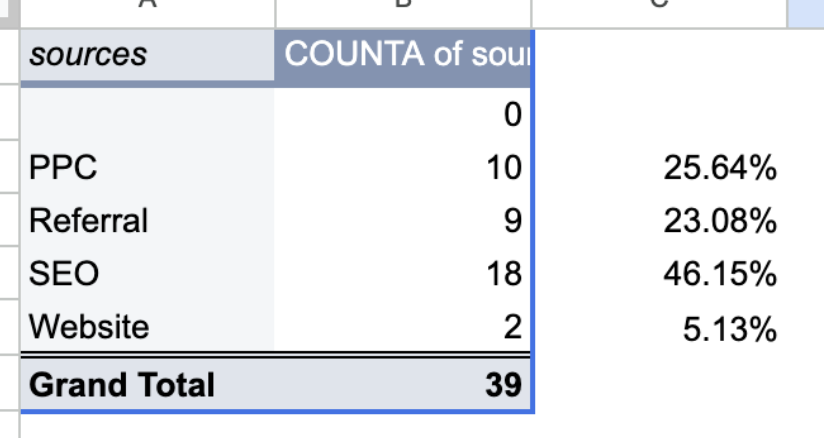
This is one of the most important findings in the analysis.
It shows that digital channels were absolutely capable of producing credible, qualified opportunities for the home side of the business. The problem was not online marketing itself. The problem was channel fit and execution.
SEO was the largest source of strong leads
Out of the 10 selected qualified leads 60% came from SEO.
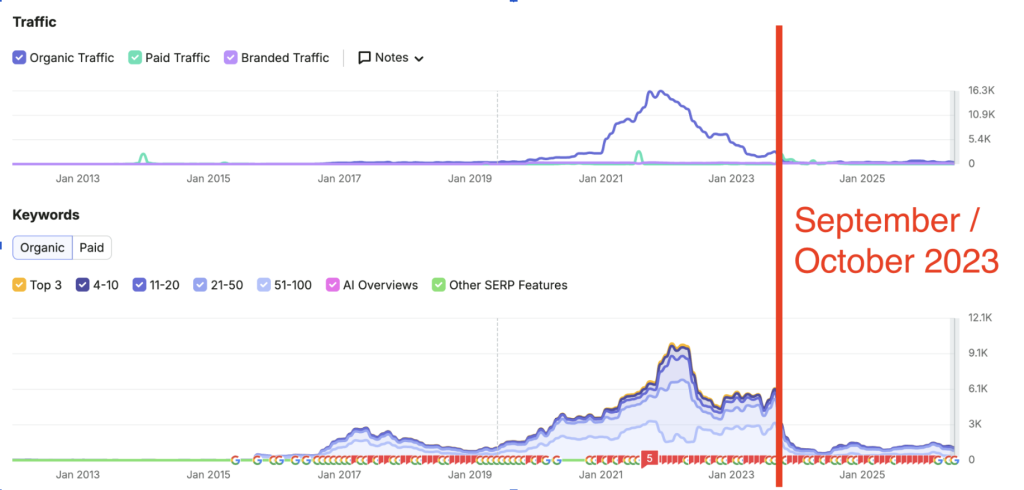
These original lead dates came from the period when the client’s SEO was performing well, roughly from 2020 through September 2023.
That is nearly 4 years of stronger organic visibility and lead flow.
But later, that SEO performance collapsed under the mismanagement of a new site launch through two previous marketing agency providers.
Based on our review, the site was relaunched and experienced major page attrition, meaning content was not properly transferred. Redirect issues may also have contributed.
In practical terms, that likely meant:
- Valuable pages disappeared.
- Historical search equity was weakened.
- Rankings and visibility dropped.
- One of the company’s strongest lead channels was damaged.
SEO recommendation
The recommended SEO recovery plan was:
- A 5-hour project to review the old sitemap and create a recovery plan.
- Follow-on implementation work to revive lost content and supporting SEO structure.
- 30 planned hours for implementation as a strong starting point.
That means:
- 5 hours for diagnosis.
- 30 hours for implementation.
- 35 hours total for the first SEO recovery phase.
PPC was the second-largest driver
Out of the 10 selected qualified leads:
- 3 came from PPC.
- 30% came from PPC.
Closed leads from January 2020 through December 2022 also showed that SEO and PPC were the company’s biggest revenue generators. That pattern was consistent across both selected lead analysis and closed-won business.
Historical PPC spend
During the January 2020 through December 2022 period, average monthly PPC spend was:
- $4,235 per month total.
- About $5,505 per month in 2026-adjusted dollars.
Of that monthly spend:
- $3,954 per month went to search.
- About $5,140 per month in 2026-adjusted dollars.
- $281 per month went to display.
- About $365 per month in 2026-adjusted dollars.
That means:
- Search accounted for about 93.4% of monthly PPC spend.
- Display accounted for about 6.6%.
Historical campaign structure
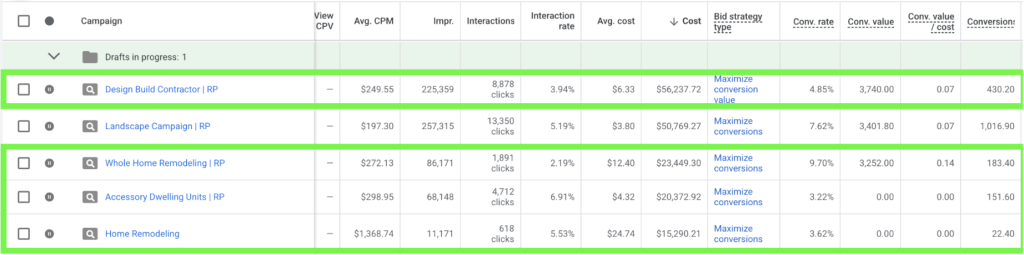
The most relevant historical campaign allocations were:
- Design Build Contractor: $1,757 per month.
- Whole Home Remodeling: $1,379 per month.
Together, those two campaigns represented:
- $3,136 per month.
That was about:
- 79.3% of the historical search budget.
Other campaigns included:
- Accessory Dwelling Units, active from April 2020 to October 2021, then shut off.
- Home Remodeling, active from March 2021 to September 2021, then shut off.
Today’s budget equivalent
The analysis used the assumption that ad costs have risen roughly 30% since January 2023.
That puts today’s comparable search budget at about:
- $5,140 per month.
Adjusted campaign benchmarks are roughly:
- Design Build Contractor: $2,285 per month.
- Whole Home Remodeling: $1,792 per month.
Combined, that equals:
- $4,077 per month.
That is why the recommendation was to revive these campaigns at around:
- $5,000 per month in monthly spend.
The recommendation is not arbitrary. It is grounded in the client’s own historical performance data and today’s cost environment.
PPC economics were still rational
Over the January 2020 through December 2022 period:
- The company closed 10 PPC leads.
That produced a closed-won PPC CPA of:
- $13,691 during the original period.
- About $17,798 in 2026-adjusted dollars.
For a design-build firm pursuing high-value residential work, that can still be a very reasonable acquisition cost.
Sales cycle length
The average PPC sales cycle during the period was:
- 241 days average.
- 213 days median.
That equals:
- About 8 months average.
- About 7 months median.

This matters because it reinforces a key point: a premium residential marketing channel cannot be judged on short-term activity alone. These are long sales cycles. The goal is qualified pipeline, not fast form fills.
What this custom home builder marketing case study proves
1. Cheap leads are not the same as good leads
A pay-per-lead model may sound lower risk, but pricing structure does not determine lead quality.
In this case, the business spent about $3,150 over 3 weeks and produced 0 qualified opportunities.
2. Meta ads for custom home builders need the right role
For high-value residential design-build services, Meta is usually better used for:
- Brand awareness.
- Prospecting.
- Retargeting.
- Assisted conversion support.
It is usually not the first channel to rely on for direct lead generation.
3. Historical data matters more than platform hype
When the business was performing well, the strongest lead sources were:
- SEO at 60%.
- PPC at 30%.
- Referral at 10%.
That means 90% of the selected qualified leads came from digital channels, and the top two channels were search-driven.
4. Broken foundations and underinvestment can hide the real issue
The data suggested 2 major underlying problems:
- Prior agencies had damaged the SEO foundation through site relaunch and content loss.
- Current PPC investment was not close to the historical budget associated with success in large residential campaigns.
The strategic recommendation
The analysis pointed to a much clearer direction.
Recover lost SEO value
Because SEO generated 60% of the selected qualified leads, it should be a priority channel.
Recommended action:
- Complete a 5-hour old sitemap and recovery review.
- Follow that with 30 hours of implementation.
- Restore high-value pages, content, and technical SEO structure.
Rebuild PPC around proven campaign themes
The PPC campaigns most aligned with the client’s goals were:
- Design Build Contractor.
- Whole Home Remodeling.
Recommended action:
- Revive both campaigns.
- Set monthly spend at about $5,000.
Keep Meta, display, and video in the correct role
For the home side of the business, these channels should continue to support:
- Awareness.
- Prospecting.
- Retargeting.
They should not be judged primarily as direct lead generation channels for custom homes and whole-home remodels.
Conclusion
This custom home builder marketing case study is not really about whether Meta ads can generate leads.
It is about whether they were being used in the right way for the right product.
A premium residential design-build company tested a generic pay-per-lead Meta advertising model built around broader remodeling demand, lower-friction offers, and templated creative. The result was about $3,150 in spend over roughly 3 weeks, 3 booked appointments, and 0 qualified opportunities.
When we looked at the company’s strongest historical lead period, the picture became much clearer:
- 60% of selected qualified leads came from SEO.
- 30% came from PPC.
- 10% came from referral.
- 90% came from digital channels overall.
At the same time:
- SEO had been weakened by site relaunch issues and content attrition.
- PPC investment was below the level historically tied to success.
- Meta, display, and video were better suited to awareness, prospecting, and retargeting than direct conversion.
That is the real takeaway.
For a custom home builder or design-build firm, the question is not whether a platform can generate a form fill. The question is whether the channel aligns with how qualified buyers actually discover, evaluate, and choose a partner for a major residential project.
The right partner to analyze your marketing performance
If your home builder or design-build marketing is generating leads but not the right leads, the next step is not necessarily more lead volume.
It is a channel strategy review.
The right analysis can show:
- Which channels historically drove qualified opportunities.
- Which foundations were damaged.
- Which channels deserve direct-response budgets.
- Which channels should support awareness and retargeting instead.
That is how you build a marketing system that supports real business growth instead of surface-level activity.
