
Luxury and custom firms often assume they have to choose between two extremes: list pricing publicly or avoid talking about price until late in the sales process. In practice, most AEC companies need something more strategic than either extreme.
Price conditioning is about shaping cost expectations before a buyer reaches proposal stage. Sometimes that means publishing pricing. Sometimes it means using messaging, cost guides, budget qualifiers, or sales materials to prepare a prospect for the level of investment your work requires.
That distinction matters.
For lower-cost or more standardized offers, public pricing can reduce wasted inquiries and improve qualification. For premium, custom, or consultative services, exposing pricing too early can hurt lead flow, create anchoring, and eliminate otherwise good-fit prospects before they understand your process or value.
The key is not to follow blanket advice. It is to test pricing strategy against your actual business goals, measure what changes, and preserve the ability to roll changes back if they hurt performance.
What Is Price Conditioning?
A simple definition
Price conditioning is the process of shaping a prospect’s expectations about cost before a sales conversation begins.
Public pricing is one form of price conditioning, but it is not the only one. AEC firms also condition pricing through copy, project examples, cost guides, qualification forms, consultation materials, and sales follow-up.
Why price expectations influence lead quality before the first call
By the time a prospect fills out a form, they already have assumptions about what your service should cost.
Those assumptions affect whether they contact you, what package they expect, how they interpret your proposal, and whether they view your firm as expensive, reasonable, or out of reach.
That is why price conditioning affects lead quality long before the first discovery call. The prospect is not only deciding whether they can afford you. They are deciding whether your offer feels aligned with the kind of company they think you are.
For luxury and custom AEC firms, this is where weak messaging creates problems. If your website says little more than “we build ADUs” or “we design custom homes,” then a premium price can feel arbitrary. If your website clearly communicates process, expertise, team structure, service level, and quality standards, that same price feels more grounded.
How Price Conditioning Shows Up in AEC Marketing
Pricing packages on design firm websites
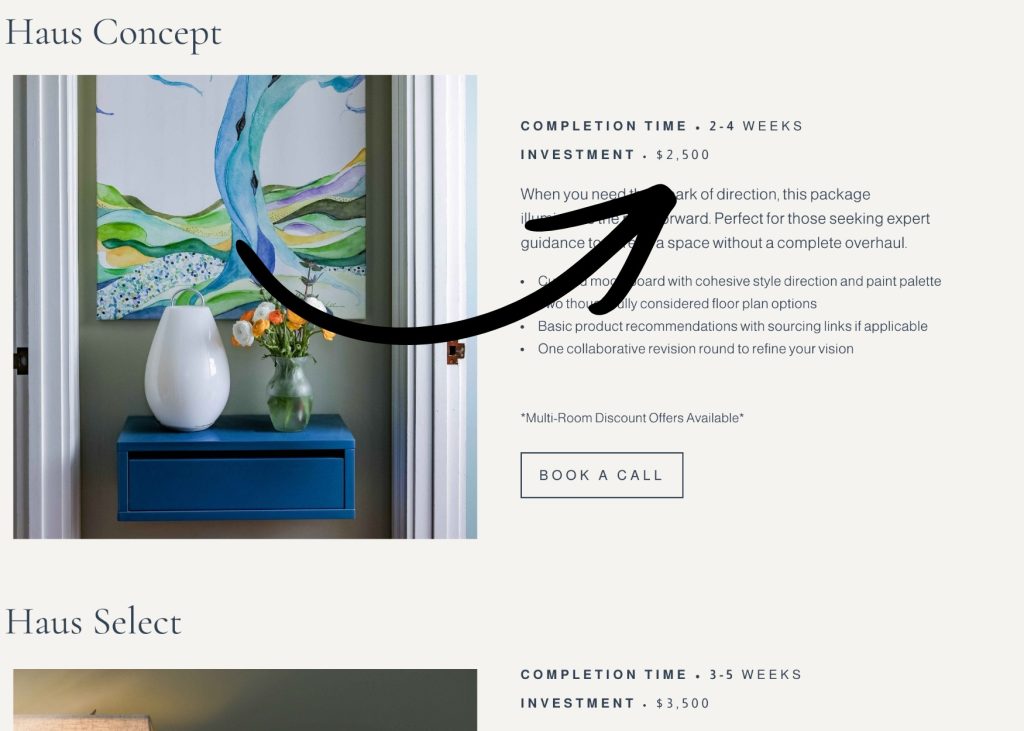
Interior designers and some design firms often publish package pricing directly on their websites. This can simplify qualification, but it can also create hard anchoring around the lowest visible option.
Remodeling calculators and cost guides
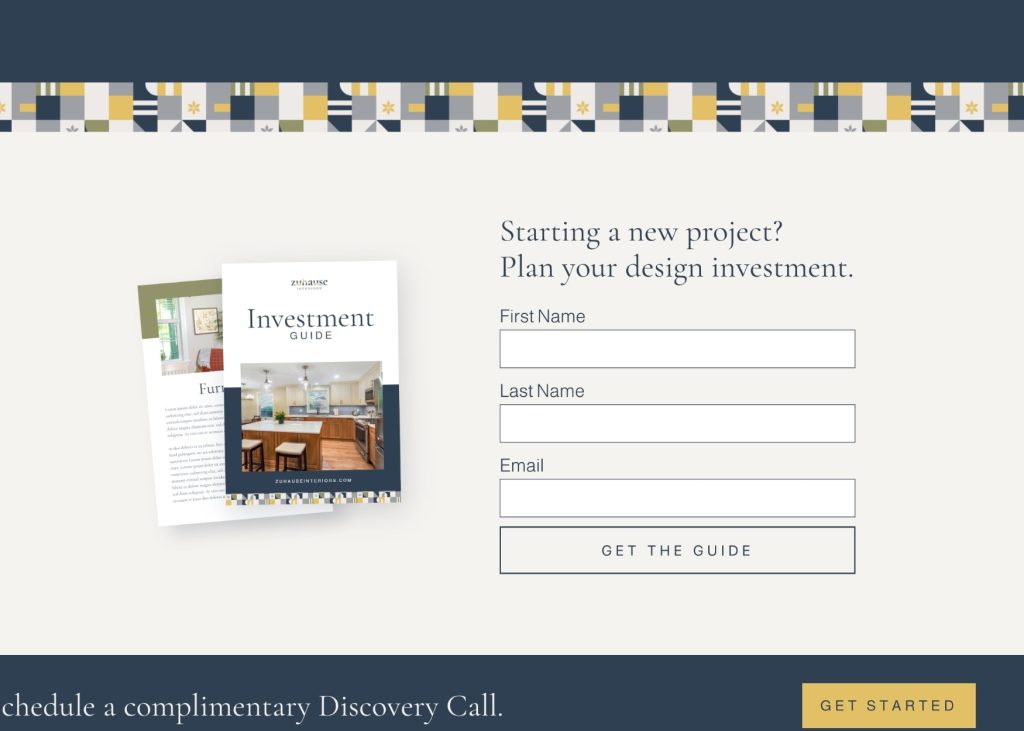
Design-build remodelers often use kitchen, bath, or addition cost guides to help prospects understand realistic investment ranges. These tools can work well when they educate rather than oversimplify.
ADU configurators and pricing tools
ADU builders sometimes test configurators that let users customize a unit and receive pricing or a saved model. These tools can increase activity at the top of the funnel, but they can also distort the sales journey if they replace the wrong conversion path.
Budget range questions on lead forms
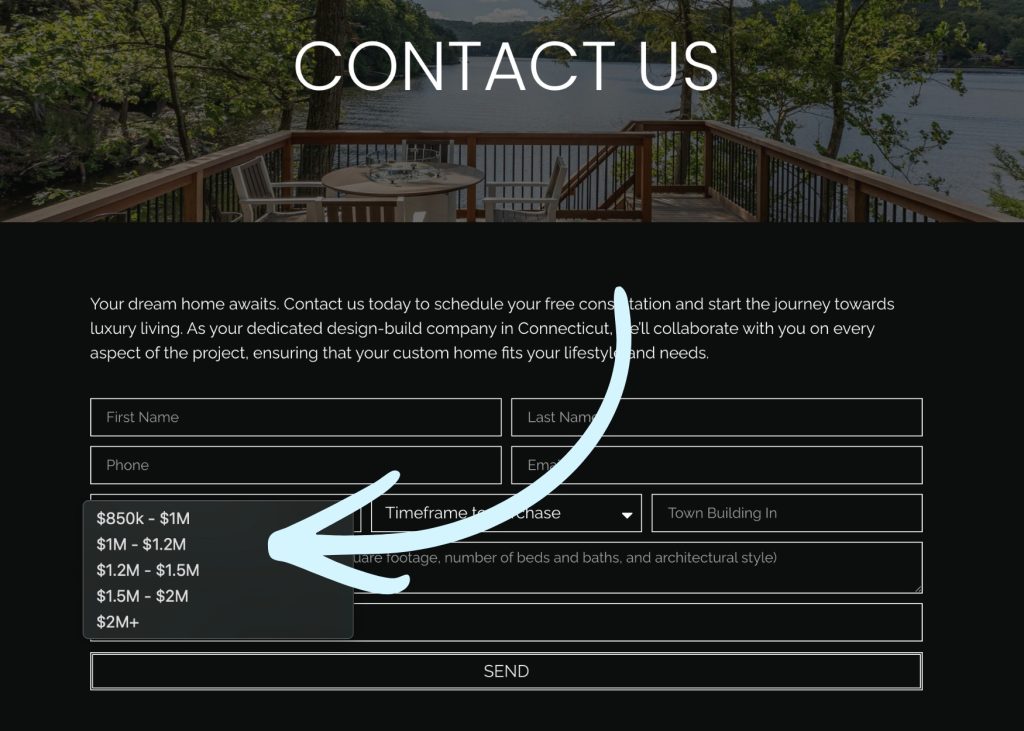
Some builders prefer not to show pricing on the public site, but they use a budget-range dropdown on the lead form. That allows them to qualify leads without publicly anchoring the market to a specific price point.
When Showing Pricing Can Help
When your firm competes on affordability or accessibility
If your company wins partly because you are accessible, price-competitive, or more standardized than alternatives, pricing visibility can support that position.
In those cases, price transparency can help the right buyers move faster.
When prospects need fast qualification
Some markets generate high inquiry volume from buyers who are quickly comparing providers. In those cases, pricing can reduce friction and help people self-select more efficiently.
When pricing transparency reduces wasted inquiries
Showing pricing can help if it filters out leads that will never be viable and allows the sales team to focus on people who are closer to budget fit from the start.
That said, this only helps when the price shown reflects the actual buying reality. If the pricing is too simplified, it may qualify the wrong people just as easily as it filters out the wrong ones.
When Showing Pricing Can Hurt
When services are custom and scope varies too much
Many AEC services are not standardized enough for clean website pricing. Scope, site conditions, finish level, permitting, and client decision-making all affect cost.
When the real answer is “it depends,” a neat number on a webpage can create more confusion than clarity.
When buyers anchor to the lowest option
Anchoring is one of the biggest risks of public package pricing. Once a buyer sees a low package or entry-level number, that number can become their internal expectation, even when their actual needs exceed it.
This makes upselling harder and can create friction later in the sales process.
When premium firms need to sell process and value first
Luxury firms often need to establish why they cost more before exposing exact numbers. If the buyer sees a premium price before they understand the team, process, quality, communication, and experience behind it, they may disqualify the firm too early.
When sticker shock eliminates good-fit prospects too early
Some prospects can afford the work, but they need context before the number makes sense. If public pricing creates sticker shock too soon, you may lose good-fit opportunities that could have converted with better education and positioning.
Real Examples of Price Conditioning Challenges in AEC
Interior designer package pricing created the wrong expectations
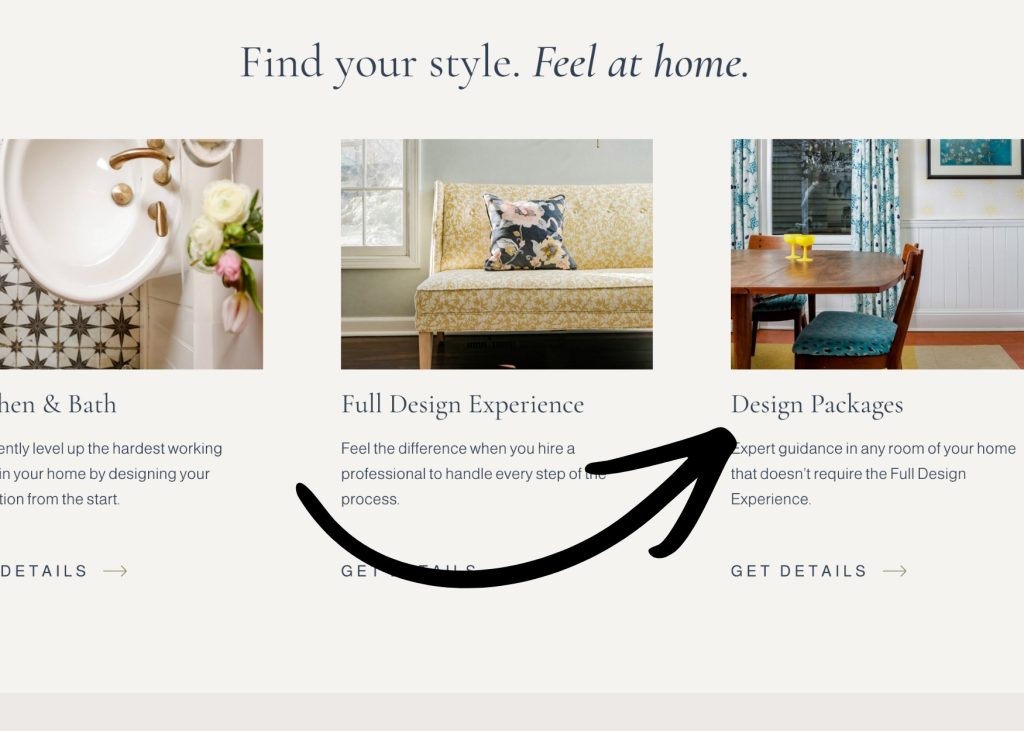
One interior designer in Pittsburgh had package pricing on her website for a long time. Over time, prospects began coming in already attached to specific package expectations.
That sounds efficient on the surface. In practice, it created the wrong expectations.
Leads self-selected the lowest tier before discovery
The core issue was not just that people referenced packages. It was that many buyers anchored themselves to the cheapest option before discovery, even when the scope they wanted clearly required more. That made upselling harder and weakened the sales conversation from the start.
This is a common problem with public pricing in premium service businesses. The website simplifies the offer, then the sales team has to re-complexify it later.
An ADU configurator reduced conversion performance
In another case, an ADU builder tested a configurator tool that allowed prospects to customize a unit and submit their information. The theory was that a more interactive experience would increase conversions.
At the top of the funnel, it did improve site-visit-to-lead conversion rate by 22 percent with 95 percent certainty. But those configurator leads converted to site visits 560 percent worse than standard leads, with 100 percent certainty. To break even, the configurator would have needed to produce 5.6 times as many leads. Instead, it absorbed a large share of site traffic and hurt downstream performance overall.
That is the clearest example of why price conditioning tools should not be judged by lead count alone. A lift in lead capture does not matter if those leads perform dramatically worse deeper in the funnel.
What Actually Determines Whether Price Conditioning Works
Market position
The biggest factor is where your company sits in the market. Firms positioned around affordability can often benefit more from visible pricing. Firms positioned around premium service, custom scope, or high-touch process need to be more cautious.
Price point
As price rises, the risk of premature disqualification rises with it. Higher-ticket services usually require more context before buyers can interpret cost correctly.
Complexity of scope
The more variables that affect pricing, the less reliable exact public pricing becomes. A standardized offering can tolerate more transparency. A custom process usually cannot.
Sales process maturity
If your team has a strong consultative sales process, public pricing may not be necessary. You may be better served by using the website and follow-up process to educate buyers first, then qualify budget more deliberately.
Buyer intent and education level
Some buyers are ready to compare providers and budgets immediately. Others are still learning what drives cost. The less educated the buyer, the more important expectation-setting becomes.
Alternatives to Listing Exact Prices
Starting-at pricing
A starting investment can help frame expectations without pretending every project costs the same amount. But beware, some people have a hard time understanding that starting at price is essentially the equivalent of a stock car with no upgrades.
Budget ranges by project type
Ranges are often more useful than exact prices for custom work. They give structure without oversimplifying.
Cost driver education
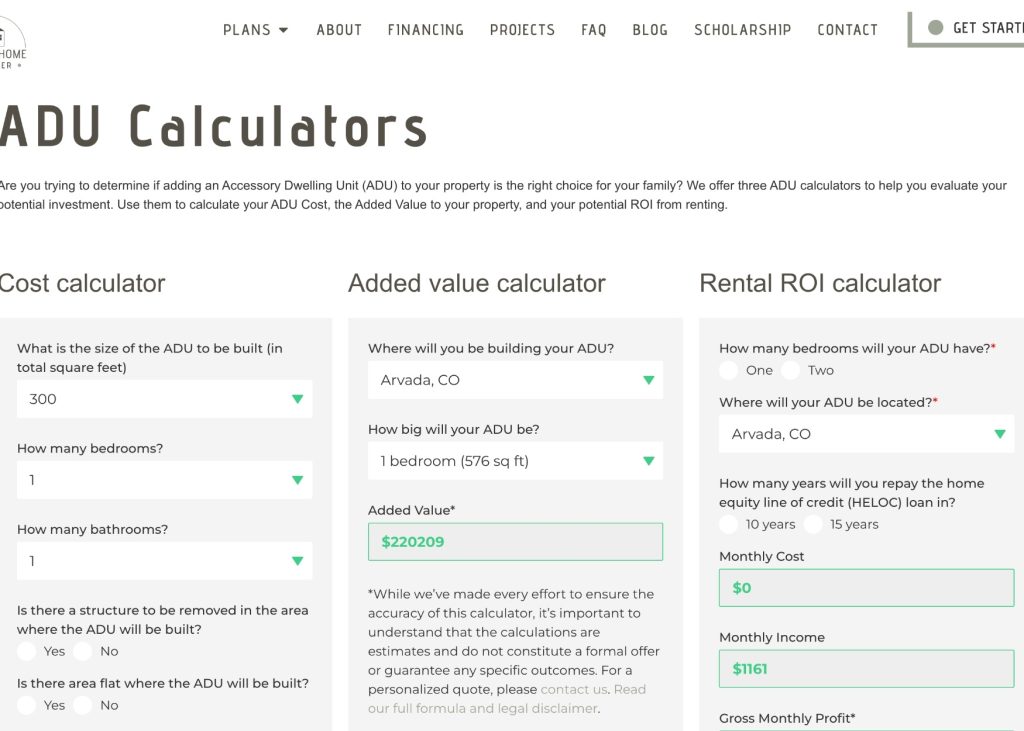
For premium firms, this is often the safest middle ground. Instead of focusing only on the number, explain what affects price: scope, materials, site complexity, team involvement, service level, and process. Here’s an example of an excellent ADU calculator which educates prospects on not only expected costs but expected value and return of the investment.
This is still price conditioning. It just conditions price through understanding instead of exposure.
Lead form qualification fields
A budget-range question on a form can help qualify leads without posting hard pricing on the public website. This works best when the rest of the site has already prepared the buyer for what your work involves.
Consultation-first pricing conversations
Some firms should avoid exact website pricing altogether and use the initial consultation to frame budget realistically. This is especially true when the sales process needs room to explain value before the buyer sees a number.
How AEC Firms Should Test Price Conditioning
Measure lead volume, not just lead quality
There are two main levers to watch.
The first is total lead flow. If you start exposing pricing, fewer people may inquire. That may be acceptable if quality rises enough, but it may also mean you are losing people your team could have sold.
What makes this more nuanced is that the effect often depends on where you sit in the market. For luxury services, exposing pricing can reduce inquiry volume because prospects may rule you out before they understand the value. For lower-priced services, the inverse is often true: competitive pricing can increase inquiry volume, while uncompetitive pricing can reduce it.
Watch lead quality early in the funnel
Because AEC sales cycles are long, early indicators matter most. In practice, lead quality often means the person wants what the company provides and has a budget within an acceptable range.
That makes early qualification more useful than waiting months to compare closed-won revenue.
Compare tools, guides, and form qualifiers
Do not frame the test as only “pricing page versus no pricing page.” Compare broader approaches:
- Public pricing
- Cost guides
- Starting ranges
- Budget dropdowns
- Consultation-led expectation-setting
Often the best-performing approach is not full transparency or full opacity. It is a more deliberate mix.
Why there is no one-size-fits-all answer
This is where many agencies get the advice wrong.
If an agency tells every AEC company to put pricing on the website, or tells every premium firm to avoid it completely, they are oversimplifying the problem. Pricing strategy depends on your market position, buyer behavior, sales process, service complexity, and competitive context.
Everything in marketing is a test.
That means establishing baseline performance, making measured changes, monitoring lead flow and lead quality, and preserving the ability to reverse the decision if it hurts business outcomes.
Rollback matters here. If you remove pricing or add pricing, save the original content and structure so the change can be reversed quickly if performance drops. Too many firms make website changes without preserving what came before, which makes meaningful testing harder.
The Better Approach to Price Conditioning in AEC
Use pricing strategy to support market positioning
Price conditioning should support how you want to be understood in the market.
If you are competing on accessibility, pricing visibility may reinforce that position. If you are selling a high-touch, high-value, premium service, your first job may be to condition the buyer around why your work costs what it does before exposing exact numbers.
Luxury firms still need to condition price expectations early. They just do not always need to do it with exact public pricing.
Test what improves qualified leads and sales outcomes
The better approach is not to ask, “Should we show pricing?”
The better question is, “What form of price conditioning improves qualified opportunities without hurting overall business goals?”
That is the real strategic decision.
FAQs
Should AEC firms put pricing on their website?
AEC firms should only show pricing when it helps qualify leads, supports positioning, and does not oversimplify a custom scope. For premium or highly customized services, public pricing often needs to be handled more carefully.
Do pricing calculators improve lead quality?
Not necessarily. A pricing calculator or configurator can improve top-of-funnel conversion while hurting downstream performance. The ADU configurator case above is a good example of that tradeoff.
When does pricing transparency hurt conversions?
Pricing transparency tends to hurt when buyers anchor to the wrong number, when the scope is too custom for simple pricing, or when premium firms need to establish value before exposing cost.
What is the best way to qualify leads by budget?
For many premium AEC firms, the best middle ground is cost-driver education combined with budget qualification on the lead form. That allows the company to prepare the buyer without oversimplifying the offer.
Need a Marketing Partner to Help with Decisions like these?
Not sure whether pricing belongs on your website? Nover Marketing helps AEC firms test website messaging, pricing visibility, and qualification strategy based on market position, then measure performance in a way that can be rolled back if the change hurts results.
