
Our organic website traffic at Nover decreased 36% this year. Our business grew by 37%.
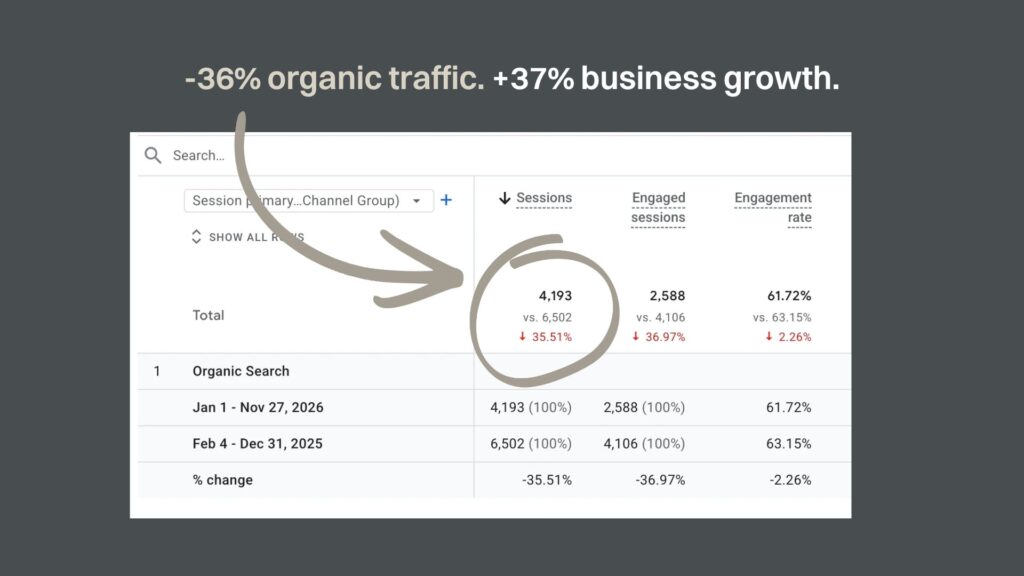
If you had evaluated our marketing performance exclusively through some of the metrics that have dominated digital marketing for the past two decades, you might have concluded that we were moving in the wrong direction.
And we’re not alone. We’re increasingly seeing a disconnect between website traffic and business performance across our clients in the architecture, engineering, construction and building products industries.
As the founder of a hybrid brand and performance marketing agency, I find this shift particularly interesting. We operate at the intersection of two marketing disciplines that have historically approached measurement very differently.
Performance marketers have enjoyed a level of perceived measurability that brand marketers haven’t had. While performance teams could point to clicks, conversions and directly attributable leads, brand teams have always had to demonstrate their value through a broader combination of indicators and longer-term business outcomes.
Now, those two worlds are increasingly converging. And frankly, I think the performance marketing industry is experiencing a rude awakening.
Our experience across both disciplines gives us a valuable perspective on this transition. We understand the importance of measurable performance, but we also understand that some of the most valuable marketing activities cannot be directly attributed to individual business outcomes.
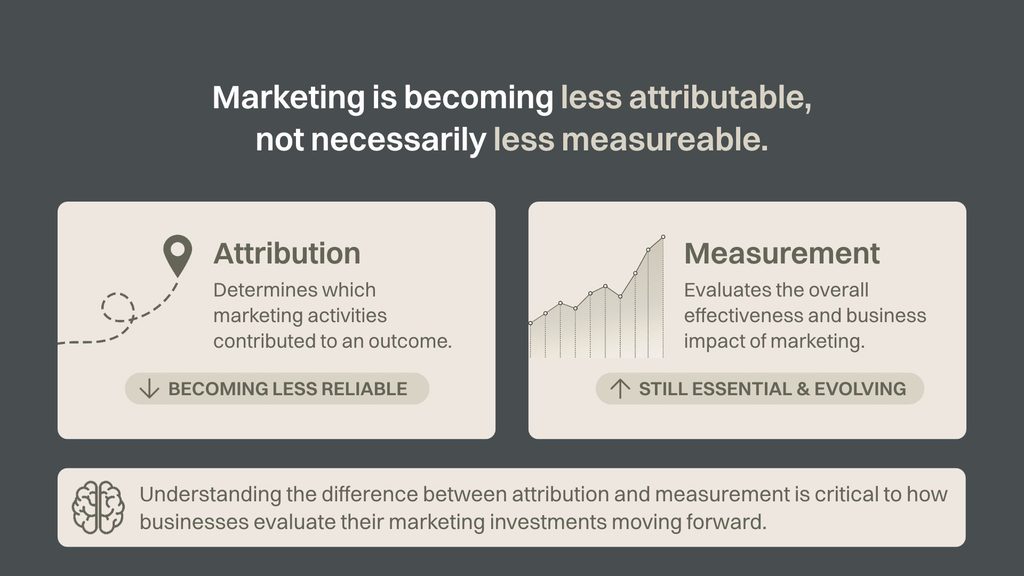
I believe marketing is becoming less attributable, not necessarily less measurable. And understanding the difference between those two things is critical to how businesses evaluate their marketing investments moving forward.
At Nover, we’re beginning the process of fundamentally rethinking how we measure marketing performance, how we report on it and how we educate our clients about what marketing success looks like in this new environment.
Here’s why we’re making that change and the framework we’re working toward.
Performance marketers have been spoiled by attribution
One of the things that made digital marketing so attractive to businesses was the promise of measurability.
Unlike a billboard, a television commercial or a print advertisement, we could show a business owner exactly how many people clicked on an advertisement, visited their website and submitted an inquiry.
We could assign conversions to individual marketing channels, calculate cost per lead and, with the right tracking infrastructure, connect those leads to revenue.
For performance marketing teams, this created an enormous advantage. We could walk into a client meeting with a dashboard full of numbers that appeared to demonstrate exactly what our work was accomplishing.
Brand marketers have never had that same luxury. They’ve historically had to demonstrate value through a combination of awareness, consideration, market penetration, customer research and longer-term business outcomes.
Now, performance marketers are increasingly facing similar challenges.
And one of my biggest frustrations with how our industry is responding to AI is the sheer amount of panic and defensiveness I’m seeing.
Website traffic was a significant leading indicator of success for many agencies. Entire service offerings, reporting frameworks and client expectations were built around increasing it. As the relationship between search visibility and website traffic changes, many marketers are scrambling to justify their performance.
In some cases, we’re responding by introducing more metrics. More impressions. More AI mentions. More visibility scores. More numbers to replace the numbers we’re losing.
But replacing one set of metrics with another doesn’t necessarily solve the underlying problem.
We need to reconsider what we’re trying to measure in the first place.
The difference between marketing attribution and marketing effectiveness
Marketing attribution and marketing effectiveness are two different things.
- Marketing attribution attempts to determine which marketing activities contributed to a particular outcome.
- Marketing effectiveness attempts to determine whether marketing investments are producing meaningful, incremental business outcomes.
Attribution asks which channel deserves credit. Effectiveness asks whether the investment made a difference.
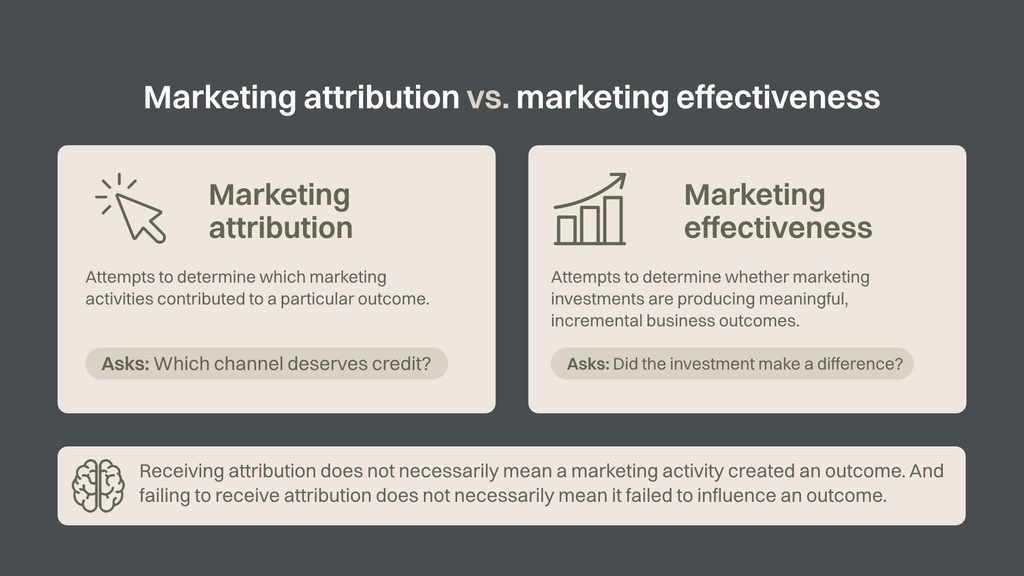
For years, our industry has frequently treated the two as interchangeable. If a channel received credit for a conversion, we assumed it was effective. If it didn’t, we questioned its value. But receiving attribution does not necessarily mean a marketing activity created an outcome. And failing to receive attribution does not necessarily mean a marketing activity failed to influence an outcome.
Consider someone who searches for a construction company’s name on Google, clicks a paid search advertisement and submits an inquiry. The advertising platform attributes that conversion to Google Ads. But what caused that person to search for the company in the first place?
Perhaps they’d been following the company on LinkedIn for six months. Perhaps a colleague recommended them. Perhaps they’d encountered the company in an AI-generated recommendation earlier that week. Google Ads may have successfully captured that demand, but it didn’t necessarily create it.
As more of the buying journey happens in environments we cannot fully observe, the limitations of treating attribution as proof of effectiveness are becoming increasingly apparent.
What an AI-generated construction lead taught us about attribution
One of our commercial construction clients was recently shortlisted for a project because a prospective customer discovered them through AI.
Fortunately, we had the lead attribution infrastructure in place to observe what happened.
The prospective customer clicked a link within an AI-generated response that referenced one of our client’s blog posts. They landed on that blog post, navigated to the contact form and submitted an inquiry, all within the same session.
We could trace the journey from AI discovery to website visit to lead generation. It was the kind of clean, observable conversion path performance marketers love.
But consider how easily that journey could have happened differently.
The AI platform could have recommended our client without the prospective customer clicking a link. That person could have opened a new browser tab, searched for the company’s name on Google and submitted an inquiry.
They could have shared the recommendation with a colleague, who then contacted the company independently. They could have researched several contractors through AI and returned to our client’s website a week later.
In any of those scenarios, AI could have played a significant role in generating the opportunity without receiving any attribution for it.
Depending on the journey and the tracking infrastructure, that inquiry might have been attributed to organic search, direct traffic or another marketing channel entirely.
The commercial value of the opportunity would have been exactly the same. Our ability to explain where it came from would have been significantly different.
That’s the challenge we’re facing.
We were fortunate to observe this particular journey, but we cannot build an entire marketing measurement strategy around the assumption that prospective customers will consistently follow clean, trackable conversion paths.
The marketing funnel is changing shape
Historically, we visualized the marketing funnel as an inverted triangle. A large number of people discover a business, a smaller number visit its website, and an even smaller number become customers.
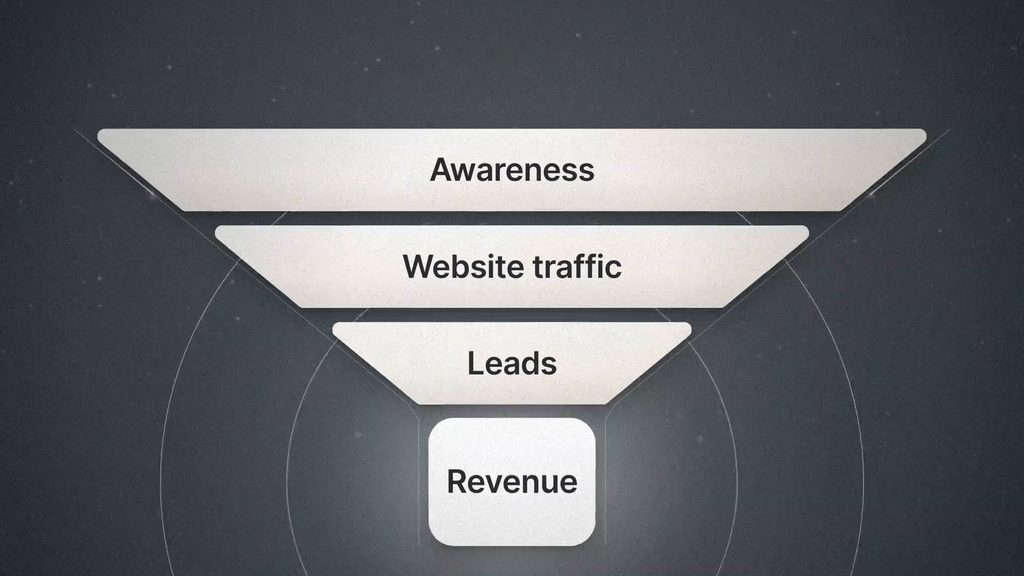
Website traffic became one of the most important leading indicators of marketing success because the website was where so much of the customer journey happened.
But what happens when people can discover, research, compare and develop preferences for businesses without visiting their websites?
A prospective custom home client can ask ChatGPT to identify builders in their area. A commercial developer can use AI to research contractors with specific technical capabilities. An architect can discover building products through social media, industry publications and AI-generated recommendations.
All of these activities can influence purchasing decisions without generating a website visit.
This is why I’ve started thinking about the modern marketing funnel as more of an hourglass.
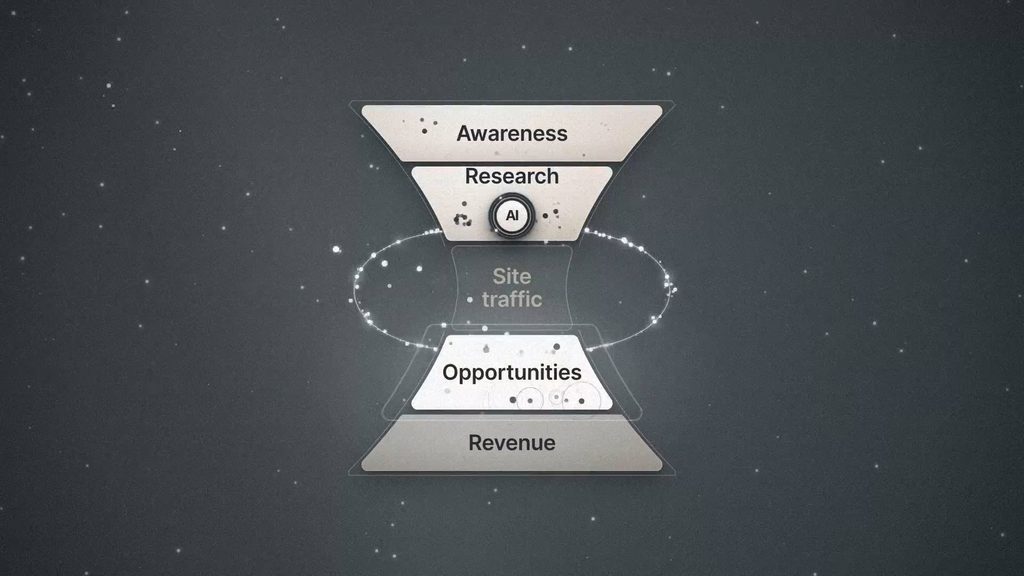
At the top, businesses have an expanding number of opportunities to reach and influence prospective customers. In the middle, website traffic becomes compressed as more research and consideration happen elsewhere. At the bottom, businesses can still generate meaningful opportunities and revenue despite fewer people passing through their websites.
Websites remain incredibly important. They’re foundational to establishing credibility, communicating expertise, supporting conversions and providing information that search engines and AI systems can interpret.
But the website is increasingly one destination within the buying journey rather than the environment where the entire buying journey takes place.
Our own business is an example of why this distinction matters. Despite experiencing a decline in website traffic, Nover grew by 37% this year.
That doesn’t prove that declining traffic is beneficial, nor does it establish which marketing activities drove our growth. But it demonstrates why website traffic alone is insufficient for evaluating business performance.
If we continue treating website traffic as one of our primary definitions of marketing success, we risk optimizing toward a metric that is becoming less representative of the outcome we’re actually trying to achieve.
Social media has been exposing this problem for years
While AI is accelerating the need to rethink marketing measurement, we’ve been having versions of this conversation with clients for years, particularly around social media.
Businesses frequently approach us with the expectation that posting on social media will generate a large audience and a consistent pipeline of directly attributable leads.
And then we discover that what they’re envisioning is three posts a week with two hours of monthly marketing investment.
Can social media generate leads directly? Absolutely. We see it happen, particularly when businesses commit to producing high-quality, differentiated content at a meaningful frequency.
But building a social media presence capable of consistently generating inbound business typically requires a significantly greater commitment than many businesses anticipate.
For many of our AEC clients, the primary role of organic social media is to build brand awareness, communicate expertise, establish credibility and influence consideration.
A prospective customer might encounter a construction company’s content repeatedly over six months before they have a project that requires that company’s services. When the need arises, they might search for the company on Google, visit its website directly or ask a colleague whether they’ve worked with them.
Social media may have played a significant role in that purchasing decision without receiving direct attribution for the resulting inquiry.
That doesn’t mean every social media strategy is effective. Posting generic content three times a week does not automatically create meaningful brand awareness, and an increase in impressions does not automatically translate into business growth.
We still need to evaluate whether we’re reaching the right audience, communicating something differentiated and generating evidence that our work is influencing consideration and demand.
But we also need to stop evaluating every marketing channel exclusively on its ability to generate directly attributable leads.
AI is making that distinction increasingly relevant across the entire marketing ecosystem, not just social media.
How we’re rethinking marketing measurement at Nover
We’re beginning the process of evaluating and restructuring our marketing measurement and reporting frameworks to better reflect how purchasing decisions are being made.
This includes evaluating what we can reliably measure, what new metrics we can incorporate into our reporting dashboards, how we connect marketing performance to business outcomes and how we educate our clients about these changes.
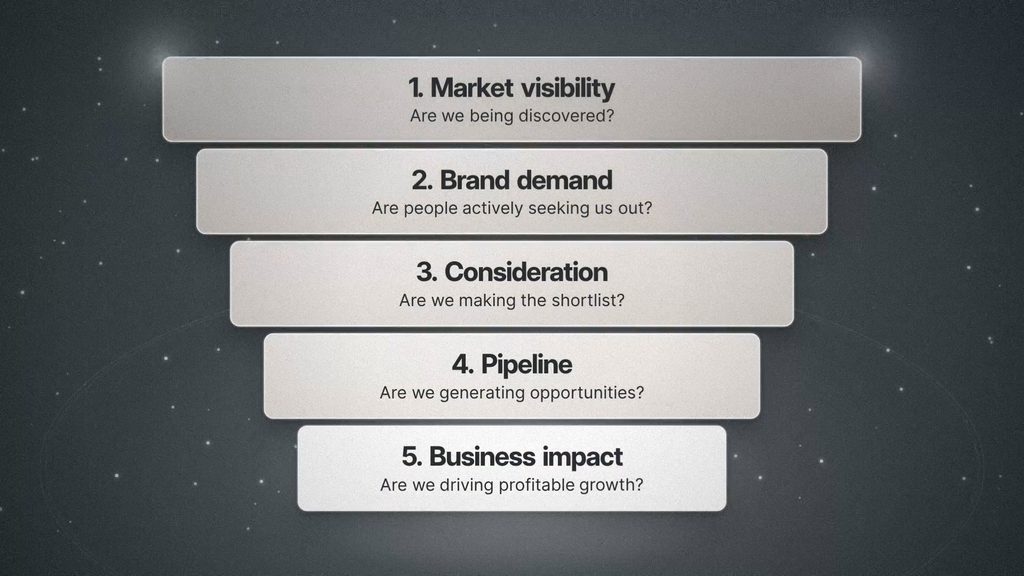
We’re organizing this evolution around five fundamental questions:
- Are more of the right people discovering your business?
- Are more people actively seeking out your business?
- Is your business being considered for the work you want to win?
- Are you generating more qualified business opportunities?
- Is your marketing investment contributing to profitable growth?
These five questions represent different layers of marketing effectiveness. Together, they provide a more comprehensive foundation for evaluating marketing performance than any individual channel, platform or attribution model.
Layer one: Market visibility

Are more of the right people discovering your business?
The first objective of marketing is to increase the probability that the right people encounter your business.
Historically, we’ve measured digital visibility through search engine rankings, advertising impressions, website traffic and social media reach. Those metrics remain useful, but they represent an increasingly incomplete picture of market visibility.
We also need to understand whether businesses are appearing in AI-generated recommendations, being mentioned in relevant conversations and establishing visibility across the platforms their prospective customers use to research purchasing decisions.
The metrics we’re evaluating for this layer include:
- Organic search visibility for relevant nonbranded queries.
- Competitive share of voice.
- AI-generated brand mentions and citations.
- AI recommendation frequency.
- Reach among relevant target audiences.
- Paid advertising impression share.
- Social media reach and impressions.
- Visibility within relevant industry publications and third-party platforms.
Importantly, we want to prioritize the quality of visibility, not simply the quantity.
For a commercial construction company, reaching 2,000 developers, architects and relevant decision-makers may be significantly more valuable than reaching 100,000 people who will never influence a purchasing decision.
Similarly, appearing in an AI-generated recommendation for a highly relevant commercial project may be more valuable than appearing in hundreds of generic search results.
Where possible, we also want to evaluate visibility relative to competitors. Absolute impressions can fluctuate based on seasonality, market demand and platform behavior. Competitive visibility can help us understand whether a business is gaining or losing ground within its market.
The objective isn’t simply to become more visible. It’s to become more visible to the people who matter.
Layer two: Brand demand
Are more people actively seeking out your business?
I believe brand demand is going to become an increasingly important component of marketing measurement.
There is a meaningful difference between someone encountering your business and someone intentionally seeking it out.
A prospective customer might discover your company through LinkedIn, an AI-generated recommendation, an industry publication or a conversation with a colleague. When that person subsequently searches for your company’s name, we have an observable signal of brand interest, even if we cannot identify what originally created it.
This makes branded search particularly interesting as a marketing metric.
The metrics we’re evaluating for this layer include:
- Branded search impressions.
- Estimated branded search volume.
- Growth in branded search demand.
- Share of branded search relative to competitors.
- Direct website traffic.
- Returning website visitors.
- Aided and unaided brand awareness, where practical.
Share of search is especially interesting because it allows us to evaluate brand demand relative to competitors. Rather than simply asking whether more people are searching for a business, we can evaluate whether that business is capturing a greater proportion of branded search activity within a defined competitive set.
This is particularly useful when overall market demand is changing.
A construction company might experience declining absolute search demand during an economic downturn while simultaneously increasing its share of branded search relative to competitors. Those two metrics tell very different stories.
Of course, branded search isn’t a perfect indicator of marketing effectiveness. Existing customers, recruitment, public relations, offline activities and other factors can all influence branded search volume. Direct website traffic can also include visits that analytics platforms were unable to attribute properly.
These metrics need to be interpreted in context. But when evaluated alongside other indicators, they can help us understand whether increased visibility is translating into genuine interest.
Layer three: Consideration and preference
Is your business making the shortlist?
Visibility alone is not enough. A business can be highly visible without being seriously considered for the work it wants to win.
This is particularly important in AEC, where purchasing decisions are often complex, high-value and made over extended periods of time.
For a commercial general contractor, the objective isn’t necessarily to generate thousands of website visitors. It might be to become one of the five companies a developer considers for a $20 million project.
Generative AI introduces an entirely new dimension to this stage of the marketing funnel.
Potential customers can ask AI platforms to identify businesses based on highly specific criteria, including geographic coverage, technical capabilities, project experience, certifications and reputation.
We need to understand not only whether AI knows a business exists, but whether it understands what makes that business qualified and differentiated.
The metrics we’re evaluating for this layer include:
- Recommendation frequency across commercially relevant AI prompts.
- AI recommendation frequency relative to competitors.
- Prominence within AI-generated recommendations.
- Accuracy of AI-generated descriptions of the business.
- Association with desired services, capabilities and differentiators.
- Shortlist frequency.
- Invitations to bid or respond to RFPs.
- Prospect-reported reasons for considering the business.
One of my concerns with the evolution of generative engine optimization (GEO) measurement is that our industry could simply replace traditional vanity metrics with AI vanity metrics.
A business appearing in hundreds of AI-generated responses doesn’t necessarily mean it’s becoming more competitive.
We need to understand what questions are being asked, how commercially relevant those questions are, what AI is saying about the business and whether the business is being recommended for the opportunities it actually wants to pursue.
We also need to acknowledge that AI visibility measurement is still evolving. Responses vary across platforms, prompts, users and time. We generally don’t have comprehensive access to the actual volume of prompts prospective customers are using.
Consistent prompt sets, repeated observations and competitive benchmarking can provide valuable directional insights, but a recommendation frequency of 30% does not mean 30% of a business’s prospective customers are seeing that business recommended.
We need to be careful not to create another illusion of precision.
The ultimate objective of GEO isn’t to maximize the number of times a company is mentioned by AI. It’s to increase the probability that the company is considered for commercially valuable opportunities.
Layer four: Qualified pipeline
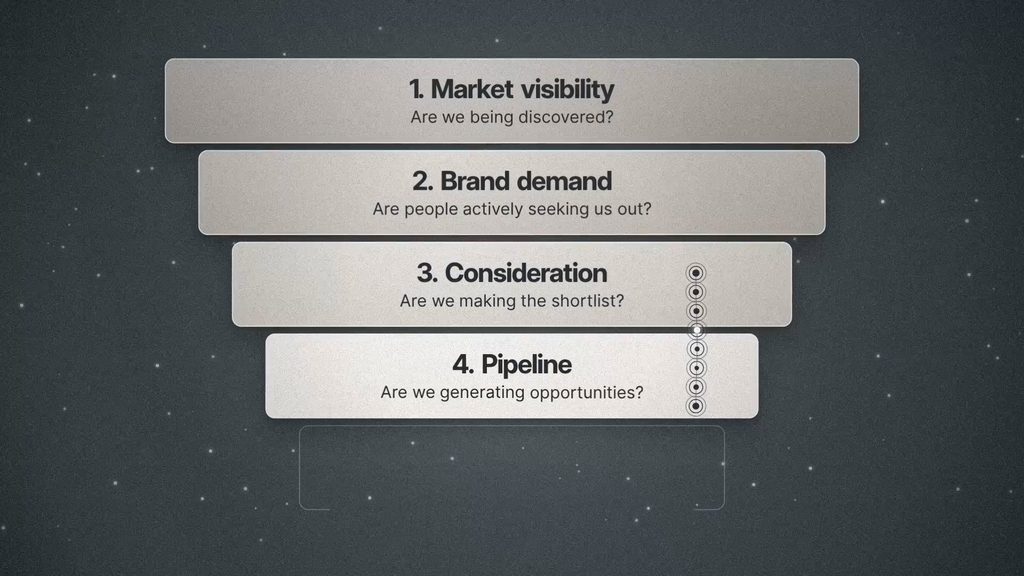
Are you generating more qualified business opportunities?
This is where marketing measurement needs to become increasingly integrated with sales and business development.
For too long, agencies have evaluated their performance primarily through lead volume and cost per lead. While those metrics are useful for campaign optimization, they often tell us very little about the actual commercial value of the opportunities being generated.
A custom home builder receiving 100 inquiries from people with insufficient budgets may be in a worse position than a builder receiving ten inquiries from highly qualified prospects.
A commercial contractor generating a single multimillion-dollar opportunity may see more potential value from its marketing investment than a competitor generating hundreds of low-value leads.
The metrics we’re prioritizing for this layer include:
- Total inquiries.
- Qualified inquiries and opportunities.
- Inquiry-to-opportunity conversion rate.
- Cost per qualified opportunity.
- Qualified pipeline value.
- Average potential project value.
- Invitations to bid.
- Opportunity progression.
- Sales cycle length.
This is an area where we’ve already invested considerable effort at Nover.
With our clients, we either have access to their CRM or maintain a shared lead-tracking spreadsheet. We require clients to provide feedback about lead quality, potential project value, close rates and other information that helps us understand what happens after an inquiry is generated.
That information is essential because a marketing platform cannot necessarily distinguish between a $500,000 opportunity and an inquiry that has no commercial value.
Without feedback from the business, marketers can inadvertently optimize campaigns toward inexpensive conversions rather than valuable opportunities.
The goal isn’t simply to generate more leads. It’s to generate more opportunities that align with the business’s capabilities, profitability objectives and growth strategy.
Layer five: Business impact
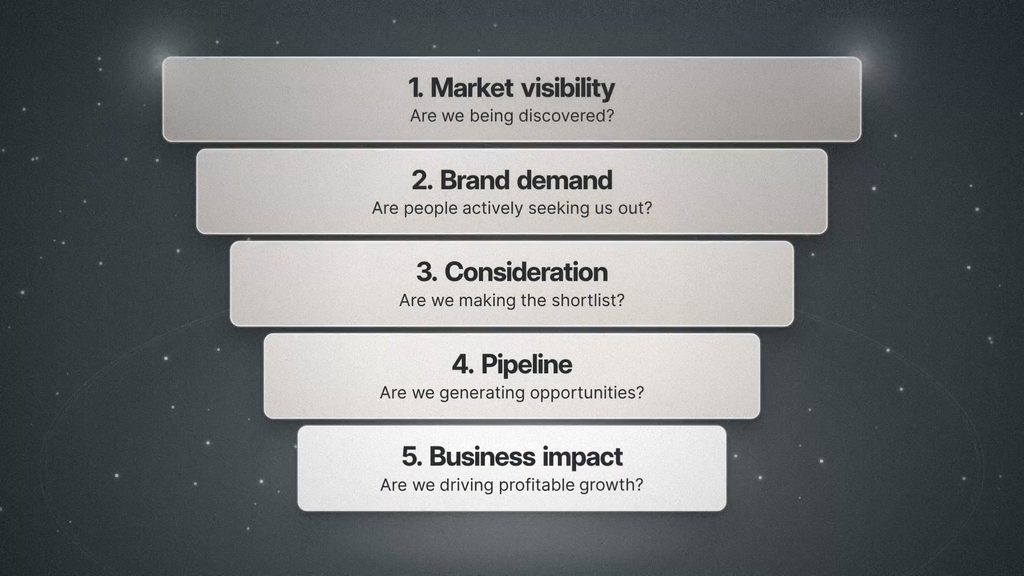
Is your marketing investment contributing to profitable growth?
Ultimately, marketing is a business investment. Its value cannot be evaluated exclusively through platform metrics, visibility or even pipeline growth.
Businesses need to understand whether their marketing investments are contributing to financially sustainable growth.
The metrics we’re evaluating for this layer include:
- New customer revenue.
- Gross profit generated from new customers.
- Blended customer acquisition cost.
- Opportunity-to-customer conversion rate.
- Win rate.
- Revenue relative to marketing investment.
- Customer lifetime value, where applicable.
- Incremental revenue and gross profit, where measurable.
However, marketing does not operate independently of the rest of the business.
Sales processes, pricing, operational capacity, economic conditions, reputation and competitive dynamics all influence whether marketing-generated opportunities ultimately become profitable customers.
An increase in revenue does not automatically prove that marketing was effective. Similarly, a decline in revenue does not automatically indicate that marketing failed.
This is why we need to evaluate business outcomes alongside the other layers of our measurement framework and account for external factors wherever possible.
The objective is not to claim credit for every dollar of revenue a business generates. It’s to understand whether marketing is making a meaningful contribution to the business’s overall performance.
What happens when website traffic declines but business performance improves?
Consider a hypothetical construction company with the following year-over-year marketing performance:
| Metric | Year one | Year two | Change |
|---|---|---|---|
| Website traffic | 10,000 | 7,000 | -30% |
| Branded search demand | 1,000 | 1,400 | +40% |
| AI recommendation frequency | 8% | 31% | +23 percentage points |
| Qualified opportunities | 20 | 32 | +60% |
| Qualified pipeline value | $4 million | $6.2 million | +55% |
Under a traditional marketing reporting framework, an agency might spend a significant portion of its client meetings explaining why website traffic has declined by 30%.
Under a marketing effectiveness framework, the conversation looks considerably different.
The business is experiencing greater brand demand, stronger AI discoverability, more qualified opportunities and a larger potential pipeline of work.
While we would still investigate the decline in website traffic, it would not automatically become the primary problem we’re trying to solve.
We would also investigate whether the improvement in pipeline was related to marketing activity, changes in market demand, business development efforts or other factors.
But reallocating marketing resources toward recovering historical website traffic simply because it has declined could be counterproductive.
We shouldn’t optimize marketing toward recovering historical metrics just because those metrics were once considered important.
We should optimize marketing toward achieving business objectives.
How do we demonstrate marketing effectiveness without perfect attribution?
One of the legitimate concerns businesses have about the changing marketing landscape is accountability.
If we can’t track every interaction, how do we know whether our marketing investment is actually working? Are businesses simply supposed to trust their agencies when they say that increased visibility and brand awareness will eventually translate into revenue?
I don’t believe that’s an acceptable answer.
Declining attribution is not an excuse for declining accountability. If anything, it requires us to become more sophisticated about how we demonstrate marketing effectiveness.
Rather than relying on a single measurement methodology, we need to combine multiple sources of evidence.
Digital attribution
Traditional digital attribution still has an important role to play.
Tracking website conversions, advertising performance, referral traffic and observable customer interactions helps us understand how people engage with a business. We should continue investing in accurate tracking infrastructure, lead attribution, CRM integration and conversion measurement.
Our commercial construction client who was shortlisted for a project through AI is a perfect example of why this infrastructure remains valuable.
What needs to change is our interpretation of that data.
Digital attribution provides a record of observable interactions. It does not necessarily provide a complete explanation of what caused a customer to convert.
We need to continue measuring what we can observe without pretending that what we can observe represents everything that happened.
Self-reported attribution
As more of the buying journey happens outside trackable digital environments, asking customers about their experiences becomes increasingly important.
Historically, businesses have relied on a single question: How did you hear about us?
But discovering a business, developing confidence in a business and deciding to contact a business are three different things.
We want to encourage businesses to ask prospective customers three separate questions:
- Where did you first hear about our company?
- Where did you encounter or research our company before contacting us?
- What ultimately made you decide to contact us?
The second question should allow for multiple answers, including AI platforms, social media, search engines, referrals, industry publications and the company’s website.
For businesses with relatively low lead volume and high transaction values, these questions can be incorporated into initial sales conversations rather than adding unnecessary friction to website contact forms.
Self-reported attribution has limitations. People forget interactions, misremember sequences and may not recognize everything that influenced their decisions.
But it can help uncover marketing interactions that would otherwise remain invisible to analytics platforms.
Incrementality testing
Incrementality testing attempts to answer one of the most important questions in marketing: What happened because of our marketing investment that would not otherwise have happened?
Rather than simply measuring how many conversions a campaign received credit for, we evaluate whether exposure to that campaign produced additional outcomes.
Consider a business running branded search advertisements. Those advertisements may receive credit for a significant number of conversions, but how many of those prospective customers would have clicked the company’s organic listing and converted anyway?
An appropriately designed experiment can help us estimate whether those advertisements are generating additional business or primarily capturing demand that would have converted through another channel.
Similarly, a business operating across multiple geographic markets might increase advertising investment in one market while maintaining its existing strategy in another comparable market.
By evaluating differences in performance and accounting for relevant market conditions, we can begin to estimate the incremental impact of that investment.
Where sufficient audience size and conversion volume exist, randomized holdout experiments can provide even stronger evidence.
Not every business has the scale or data necessary to conduct reliable incrementality tests. This is particularly relevant in commercial construction, where a business might generate relatively few opportunities each year.
But where practical, experimentation can help us move beyond correlation and toward a better understanding of causation.
Brand lift measurement
Brand lift studies evaluate whether marketing exposure changes how an audience perceives or remembers a business.
Rather than measuring whether someone clicked on an advertisement, we might evaluate whether exposure increased brand awareness, familiarity, consideration or purchasing preference.
This is particularly relevant for businesses with long sales cycles, where prospective customers might encounter marketing content months or even years before they’re ready to make a purchasing decision.
For smaller businesses, structured customer interviews, prospect surveys and periodic market research can provide more accessible, although less rigorous, ways to evaluate changes in brand perception.
Performance marketing teams have historically underutilized some of these methodologies because they’ve had access to more immediate, directly attributable conversion data.
I think we’ll increasingly see the measurement practices of brand and performance marketing converge, with businesses benefiting from a more integrated understanding of how awareness, consideration and conversion influence one another.
Marketing mix modeling
Marketing mix modeling uses historical data and statistical methods to estimate how different marketing investments contribute to business outcomes over time.
Rather than attempting to track individual customers across every touchpoint, it evaluates aggregate relationships between marketing activity, external factors and business performance.
For larger organizations with sufficient historical data, marketing investment and conversion volume, this can be a valuable tool for evaluating budget allocation.
However, many small and midsize AEC businesses do not have enough reliable data or variation in marketing investment to support sophisticated marketing mix models.
As an agency, we need to be realistic about which measurement methodologies are appropriate for the businesses we serve.
A complicated statistical model built on insufficient data does not necessarily produce better insights than a simpler, well-designed measurement framework.
Our objective is to improve the quality of our decision-making, not to introduce analytical complexity for the sake of it.
The future of marketing analytics is triangulation
No single measurement methodology provides a complete picture of marketing effectiveness.
Traditional attribution misses unobservable interactions. Self-reported attribution is subject to human memory. Competitive visibility does not necessarily translate into revenue. Business outcomes can be influenced by factors outside marketing’s control.
The solution is to evaluate multiple sources of evidence together.
Consider a business that experiences the following changes over a twelve-month period:
- Increased visibility among its target audience
- Increased AI recommendation frequency
- Growth in branded search demand
- More prospects reporting exposure to its content
- More invitations to bid on relevant projects
- Growth in qualified pipeline
- Improved customer acquisition economics
Individually, none of these indicators necessarily proves that a particular marketing activity caused a particular business outcome.
Collectively, they provide a much stronger foundation for evaluating whether the overall marketing strategy is producing meaningful results.
This is known as triangulation: using multiple measurement methods and data sources to evaluate a question rather than relying exclusively on one.
The strength of this approach depends on the quality of the underlying evidence. Multiple metrics moving in the same direction can still be influenced by a common external factor, such as an improving economy.
Where possible, controlled experiments, competitive benchmarking and analysis of external market conditions can strengthen our understanding of what’s actually driving performance.
This is the direction we want to move our marketing analytics at Nover. Less dependence on any single source of attribution and greater emphasis on building a comprehensive, evidence-based understanding of marketing effectiveness.
Marketing measurement is a shared responsibility
One of the most important components of this evolution is something that has nothing to do with AI or marketing technology.
It’s communication between businesses and their marketing agencies.
At Nover, there is a noticeable difference between the clients who consistently communicate with us about their leads and those who don’t.
Some of our most successful client relationships are with businesses that overcommunicate about lead quality. They tell us when an inquiry is particularly promising, when a prospect doesn’t have the right budget, when an opportunity progresses and when a project is won or lost.
That information allows us to make better decisions.
We can identify patterns in the types of opportunities we’re generating, refine targeting, adjust messaging and prioritize marketing activities that appear to be contributing to commercially valuable outcomes.
Conversely, some of the client relationships where we struggle most to optimize performance are those where lead-tracking spreadsheets aren’t updated, CRM information is incomplete or feedback about lead quality is inconsistent.
We might know that we generated 30 inquiries, but if we don’t know what happened to those inquiries, there’s a significant limitation to what we can learn from them.
This is going to become even more important as traditional attribution becomes less comprehensive.
Businesses cannot reasonably expect their marketing agencies to demonstrate the commercial effectiveness of their work while withholding or failing to maintain the commercial data necessary to evaluate it.
And marketing agencies cannot expect businesses to interpret increases in impressions, reach or AI visibility as sufficient evidence of success.
Both parties have a responsibility.
The agency needs to establish meaningful measurement frameworks, implement appropriate tracking infrastructure, analyze the available information and communicate what it means.
The business needs to provide timely, accurate information about lead quality, sales outcomes, pipeline value and the commercial realities affecting performance.
Marketing measurement is increasingly going to require a partnership between marketing, sales and business leadership.
The businesses that embrace that partnership will be better positioned to make informed decisions about their marketing investments.
What businesses should expect from their marketing agencies moving forward
Businesses should not accept declining accountability as an inevitable consequence of AI and changing purchasing behavior. They should expect their marketing agencies to evolve.
That means establishing clear business objectives, identifying meaningful leading and lagging indicators, integrating marketing and sales data, evaluating competitive performance and conducting experiments where practical.
It also means being transparent about what we can measure, what we can reasonably infer and what we cannot definitively prove.
There’s a tremendous amount of pressure on marketing agencies right now to adapt quickly. The platforms we’re working with are evolving, customer behavior is changing and measurement capabilities aren’t necessarily keeping pace.
I understand why there’s so much uncertainty within our industry.
But I don’t think defensiveness is the appropriate response.
Our responsibility isn’t to defend the metrics we’ve historically used to demonstrate our value. It’s to determine whether those metrics are still serving the businesses we work with.
Sometimes marketing success will mean increasing website traffic. Sometimes it will mean increasing brand recognition, improving AI-generated recommendations or influencing purchasing decisions in environments that never generate a website visit.
The metrics we prioritize should reflect the outcomes we’re trying to achieve, not simply the data that’s easiest to collect.
Marketing measurement isn’t disappearing. It’s evolving.
The businesses that succeed over the next several years will not necessarily be the ones that recover their historical website traffic, generate the most social media impressions or achieve the lowest cost per lead.
They will be the businesses that consistently reach the right audiences, establish meaningful differentiation, build brand preference and position themselves to be considered when purchasing decisions are made.
And the marketing agencies that succeed will be the ones that can demonstrate progress toward those objectives without pretending they can track every interaction that contributed to them.
At Nover, we’re not abandoning performance marketing or the measurement infrastructure we’ve spent years developing. We’re bringing the measurement principles of brand and performance marketing closer together to develop a more comprehensive understanding of marketing effectiveness.
We’re moving from a predominantly channel-centric approach to marketing measurement toward a business-centric approach that better reflects how brand building, demand generation and demand capture work together.
That requires more collaboration between marketing and sales, better measurement infrastructure, greater analytical sophistication and a willingness to challenge the metrics our industry has historically relied upon.
It also requires us to recognize that not everything valuable can be perfectly attributed, and not everything attributable is necessarily valuable.
The future of marketing measurement isn’t about proving which channel deserves credit.
It’s about demonstrating whether the marketing system as a whole is making a business more competitive and profitable.
And that’s what we’re working toward at Nover.
