
For years, the goal of digital marketing has been relatively straightforward: get more people to your website.
More visibility meant more traffic. More traffic meant more opportunities to convert visitors into leads. And more leads, theoretically, meant more business.
But what happens when your potential customers are researching your company, evaluating your qualifications, and even scheduling meetings without ever visiting your website themselves?
That’s not a hypothetical question anymore.
At Nover Marketing, we’re already seeing it happen.
The traditional marketing funnel is changing

I’ve been taking business courses through Augment, and one concept from its AI for Marketing class particularly stood out to me: the traditional marketing funnel is evolving into something that looks more like an hourglass.
Historically, the funnel represented a relatively linear journey. A potential customer discovered your company, visited your website, learned about your services, and eventually submitted an inquiry.
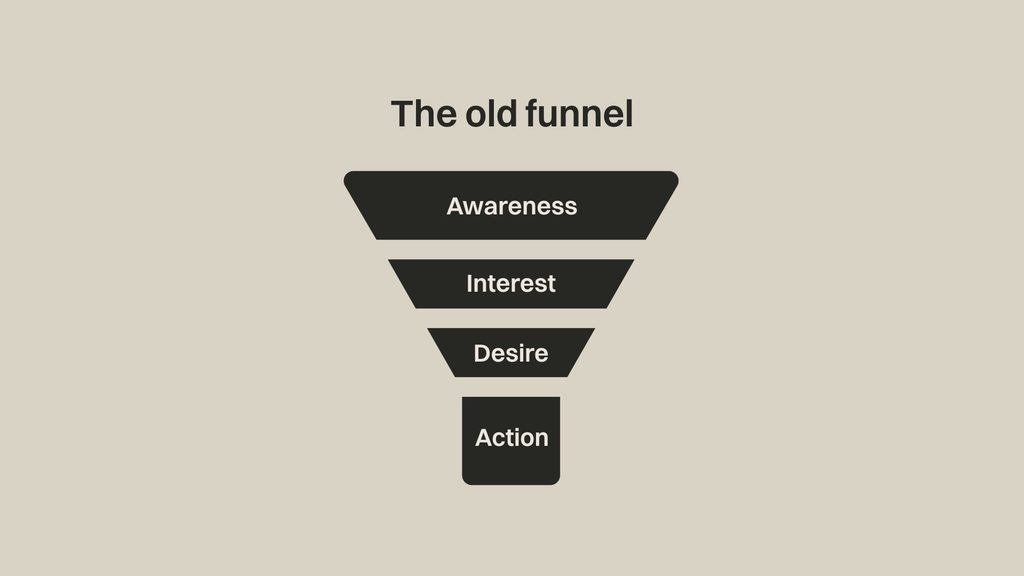
The new model challenges that assumption.
Awareness can happen across dozens of different platforms. Buyers might encounter your company through social media, industry publications, online discussions, AI-generated answers, or recommendations from their professional networks.
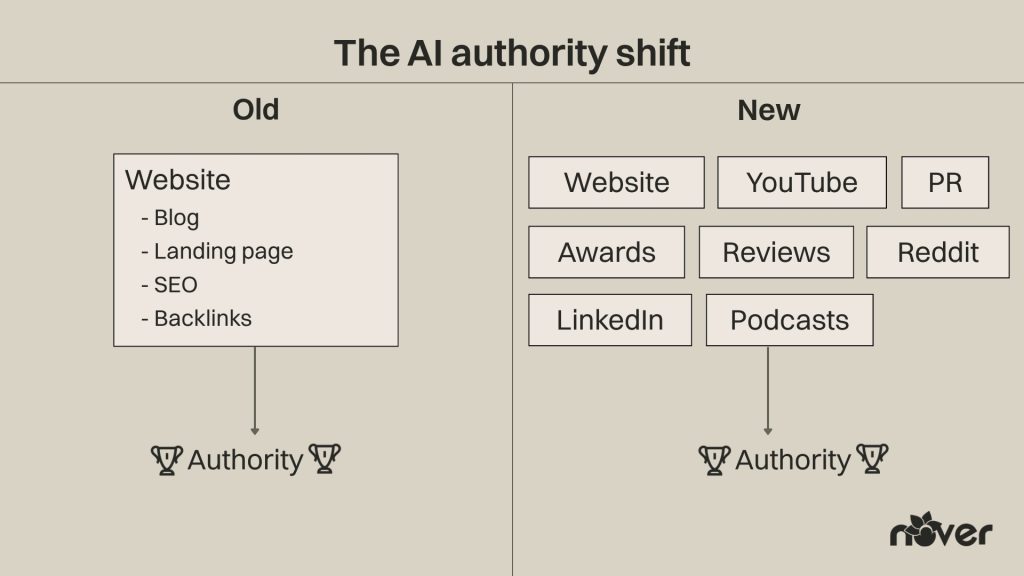
And increasingly, AI tools are helping them research and evaluate companies without requiring them to visit every website individually.
The result? Fewer people may visit your website, but those who do may be further along in their decision-making process.
That creates an hourglass-shaped journey: broad awareness, a narrower point of website visitation, and a larger group of potential customers who have already completed significant research before engaging.
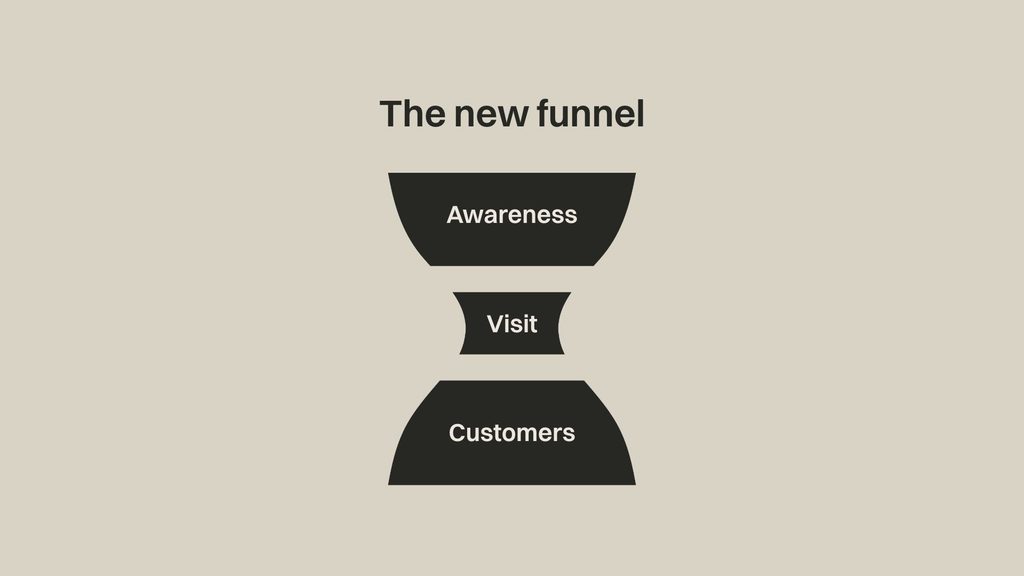
It’s an important distinction because less website traffic doesn’t necessarily mean your marketing is becoming less effective.
It may mean the buying journey is changing.
We’re already seeing AI agents generate construction leads
One of the most interesting developments we’ve observed at Nover is the emergence of AI agents as active participants in the construction buying process.
We’ve had clients receive inquiries submitted by AI agents. And these agents aren’t simply providing a list of recommended contractors.
They’re taking action.
In one instance involving a residential home builder, an AI agent completed the company’s inquiry form and booked a meeting through Calendly.
We’ve also seen this happen with a commercial construction company. An AI agent submitted an inquiry and scheduled a meeting, creating an opportunity that could potentially turn into a significant contract.
To be clear, we don’t know exactly how these agents identified or selected the companies. We can’t say whether the AI independently recommended them or whether a human directed the agent to contact specific contractors.
But we do know that AI agents completed actions that traditionally required a prospective customer to navigate a website and engage with a company’s sales process.
That’s a meaningful development.
And I find the commercial construction example particularly interesting.
Commercial contractors have historically relied heavily on relationships, referrals, reputation, and formal procurement processes to win work. Digital marketing often plays a supporting role rather than serving as the primary source of new business.
But AI-assisted research and outreach introduce another way for potential opportunities to develop.
This doesn’t mean relationships or RFPs are going away. It means the process of identifying and contacting potential construction partners may be evolving.
And construction companies need to pay attention.
Website traffic is declining. That doesn’t mean your website matters less.
Across many of our construction clients, we’ve observed declining website traffic.
There can be multiple reasons for traffic declines, and we can’t attribute every decrease directly to AI. But the pattern is consistent with a broader shift toward search experiences that answer questions without requiring users to click through to websites.
This is where I think construction companies need to reconsider how they evaluate their digital marketing.
For years, website traffic has been one of the most visible measures of marketing performance.
It’s easy to track. Easy to compare year over year. And easy to interpret as a measure of whether your marketing is working.
But traffic is ultimately an intermediate metric.
What construction companies actually need are qualified opportunities that turn into profitable projects.
If fewer people visit your website, but those who do are more qualified and more likely to inquire, declining traffic may not be the problem it initially appears to be.
And if AI tools are researching your company and initiating contact on behalf of potential customers, some of your marketing’s influence may not appear in traditional website analytics at all.
That doesn’t mean we should stop measuring traffic.
It means we need to stop treating traffic growth as the ultimate measure of success.
Your website is still incredibly important
Here’s where I think some of the conversation around AI and search gets oversimplified.
If fewer people are visiting websites, it’s tempting to conclude that websites are becoming less important.
I would argue the opposite.
Your website may become an increasingly important source of information, even when a human never visits it directly.
Consider a commercial contractor whose website clearly communicates its project experience, geographic coverage, specialized capabilities, delivery methods, and relevant industries.
That information can help a prospective customer evaluate the company. It can also provide useful context for AI systems researching potential contractors.
Now compare that with a contractor whose website contains a handful of generic service descriptions and a portfolio with almost no project details.
The second contractor may be exceptionally qualified. But if that expertise isn’t documented and accessible, it’s harder for someone—or something—researching the company to understand what makes it a strong candidate.
This is why website content remains so important.
Construction companies should be documenting the things that actually influence buying decisions: what they build, who they serve, where they operate, the complexity of projects they’ve completed, and what differentiates their approach.
Not because every potential customer will read every page.
But because the information needs to exist and be accessible wherever the research begins.
Your website isn’t becoming irrelevant. Its role in the buying journey is changing.
What construction companies should do differently
I think there are several practical implications for construction companies.
1. Stop measuring marketing success primarily through traffic
Website sessions still provide useful information, but they don’t tell the complete story.
Construction companies should pay closer attention to qualified inquiries, opportunity value, close rates, and the revenue generated by marketing.
A commercial contractor doesn’t need thousands of additional website visitors if a handful of qualified opportunities can generate millions of dollars in potential work.
2. Make your expertise easy to understand
Generic statements about quality, service, and experience aren’t enough.
Be specific about your capabilities, the types of projects you undertake, the industries you serve, and the challenges you’re equipped to solve.
Detailed project case studies, clear service pages, and useful technical information can help both human buyers and AI-assisted research processes better understand your business.
3. Build visibility beyond your website
The traditional approach of publishing content primarily to drive website traffic is becoming less complete.
Construction companies should think about how they’re represented across the broader digital ecosystem.
That includes industry publications, professional networks, project features, third-party websites, and other credible sources where potential customers may encounter information about their businesses.
Your reputation has always extended beyond your website.
Now your digital presence needs to reflect that reality.
4. Pay attention to how leads are actually arriving
We’re increasingly asking questions that weren’t part of the typical marketing conversation a few years ago.
Did a prospect find you through a traditional search engine? Did they discover you through ChatGPT or another AI platform? Did an AI agent contact you on their behalf?
Not every source will be perfectly attributable, but companies should start documenting these interactions.
Understanding how buyers discover and engage with your business will become increasingly important as the buying journey evolves.
The goal was never website traffic
One of the reasons I found Augment’s hourglass model so compelling is that it challenges a metric the marketing industry has emphasized for a long time.
Website traffic is useful. But it isn’t the end goal.
For construction companies, the goal is to build awareness with the right audience, establish credibility, generate qualified opportunities, and ultimately win profitable projects.
AI isn’t changing that objective.
It’s changing how buyers get there.
We’re still early in understanding how AI agents and AI-assisted research will influence construction purchasing decisions. But we’re already seeing enough firsthand evidence to know that the traditional website-centered funnel doesn’t tell the entire story anymore.
And I think that’s an important shift for construction companies to understand.
Your next customer may know a great deal about your business before ever visiting your website. They may even have an AI agent schedule the first meeting.
The question is whether your company is giving them—and the tools they’re using—enough information to make that decision.
