
A few years ago, an entrepreneur came to us with an idea: launch an ADU construction company and compete directly with a national, investor-backed franchise.
They had left their full-time job just two weeks earlier. There was no established brand, website, pipeline or meaningful market presence. We launched the company’s logo and website in three weeks and immediately focused on the thing a new construction company needed most: qualified leads.
Within the first year, the company generated more than 500 leads and signed more than $1 million in new business. Organic search eventually accounted for 64% of website sessions. Google Ads generated 105 leads at an average cost per lead of $47, with a 16% click-through rate.
The company continued to grow from there.
Then, in 2026, lead volume started falling.
Not a little. During our most recent analysis, July through September lead volume was running approximately 59% below the same period in 2025, with September still incomplete at the time of analysis.
But here’s where this construction lead generation case study gets interesting:
The business is still growing.
They’re doing more projects year over year and having a strong year despite generating fewer inbound leads. So, what was actually happening?
The answer wasn’t as simple as “SEO isn’t working” or “Google Ads isn’t performing.” And figuring that out before changing the marketing strategy was incredibly important.
What do you do when construction leads start declining?
When a construction company’s leads decline, it’s tempting to immediately start changing things.
Increase the Google Ads budget. Invest more in SEO. Change agencies. Redesign the website. Launch new campaigns.
Those might eventually be the right decisions. But a decline in lead volume doesn’t tell you why leads are declining. Before deciding what to change, we needed to understand what was actually happening.
In this case, there were multiple factors at play:
- The client’s geographic strategy had changed
- Ongoing SEO investment had been limited
- Organic traffic had declined
- Search behavior was changing
- Referral leads had fallen significantly
- Lead quality showed some recent deterioration
- Paid search was generating fewer conversions
- And the available search demand for the client’s core service appeared to be softening
No single metric could tell that entire story. And that’s precisely why diagnosing a construction lead generation problem requires more than looking at a marketing dashboard.
First, AI analyzed the problem. But it was missing something important.
The client brought the concern to us after trying to diagnose it themselves. They had access to Google Search Console, connected the data to an AI tool and asked AI to analyze what was happening.
That’s not a bad idea. We use AI extensively in our own marketing analysis. The problem was that AI had the data, but it didn’t have the context.
It could see changes in impressions, clicks, rankings and organic search performance. It couldn’t inherently know why some of those changes had occurred.
For example, the client had previously planned to expand into another market. We built organic visibility around that location, and the website began ranking well and generating leads there.
Then the business strategy changed. The client decided they no longer wanted to serve that market. So we stopped marketing it. We removed the location-specific content from the website, stopped prioritizing those rankings and began disqualifying leads from that area.
Eventually, traffic and leads from that market declined. From an SEO dashboard, that’s a negative trend. From a business perspective, it’s exactly what should have happened.
An AI analysis looking primarily at Search Console couldn’t understand that unless it was explicitly given the business history behind the numbers. That distinction matters. AI is extraordinarily useful for analyzing marketing data. But identifying a change in a metric isn’t the same thing as diagnosing why that change occurred.
Before making a significant marketing decision based on AI-generated analysis, you need to make sure the system has access to the business context necessary to interpret the data correctly.
A 59% decline in leads doesn’t mean marketing performance declined 59%
This is one of the biggest mistakes companies can make when evaluating construction marketing performance. Imagine opening a report and seeing leads are down 59% year-over-year. It looks terrible. But that number doesn’t tell you how much of the decline came from losing valuable prospects versus leads you intentionally stopped pursuing.
It doesn’t tell you whether your service area changed. It doesn’t tell you whether a previously successful referral source disappeared. It doesn’t tell you whether your sales team changed how it qualifies leads. And it certainly doesn’t tell you whether fewer people are actually looking for your service.
So instead of immediately prescribing a solution, we started breaking the decline apart.
Was lead quality getting worse?
One possible explanation was that marketing was simply generating worse leads.
Historically, two of the client’s biggest disqualification reasons were prospects who didn’t own land and prospects who lived outside the company’s service area.
Year over year, however, that mix hadn’t changed dramatically. Together, those reasons represented only about a 2.1 percentage-point increase in the share of disqualified leads from 2025 to 2026.
More recent data did give us something to watch. In July and August 2026, 27% of visible leads failed the land or service-area qualifications. Through September 23, that had increased to 57%.
At the same time, the meeting-booked rate dropped from 32% in July and 37% in August to 14% in September. So yes, recent lead quality and progression were concerns. But the historical data didn’t support the conclusion that worsening lead quality alone explained the overall year-over-year decline.
We needed to keep digging.
Was construction SEO performance declining?
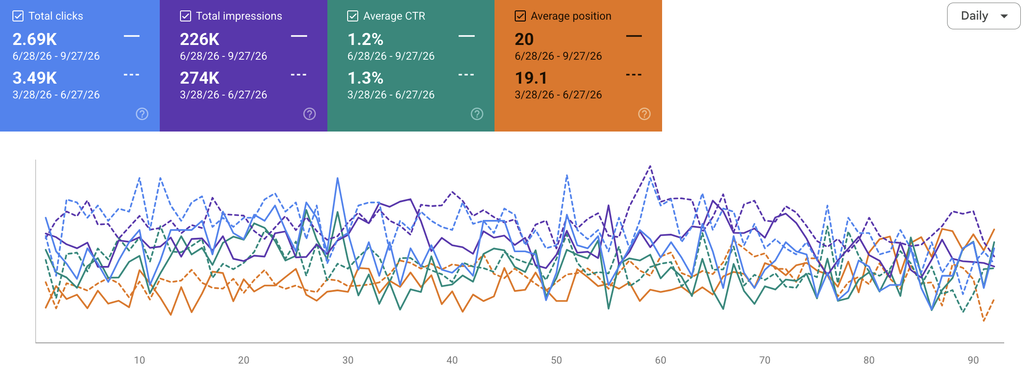
Organic search had historically been one of the strongest lead generation channels for this home builder. It still was. In July 2026, organic search generated 53 form fills. In August, it generated 38. In September, it generated 32.
But compared with 2025, organic form volume was down approximately 35% to 42% year over year during those months. Organic sessions had fallen even more: 47% in July, 48% in August and 57% in September.
There was clearly organic attrition. And some of it was explainable. As we already discussed, the company had intentionally stopped targeting one geographic market. The client also hadn’t had the budget to continue investing consistently in SEO.
Then there was the search environment itself. Search Console impressions declined from approximately 275,000 to 230,000, a 16% decrease. Clicks declined faster, falling approximately 24% from 3,540 to 2,680. Average position slipped somewhat from 19.4 to 20.3, while CTR moved from 1.3% to 1.2%. That suggests multiple things may be happening simultaneously.
There has been some ranking erosion. There was an intentional reduction in geographic SEO coverage. And the fact that clicks declined faster than impressions is at least consistent with today’s increasingly zero-click search environment, where traditional search features and AI-generated answers can reduce the number of searches that result in website visits.
But there was another important data point: third-party SEMrush visibility was actually slightly positive in our analysis rather than showing a broad collapse in search visibility. So “SEO stopped working” wasn’t a sufficient explanation either.
Then Google Ads gave us another clue
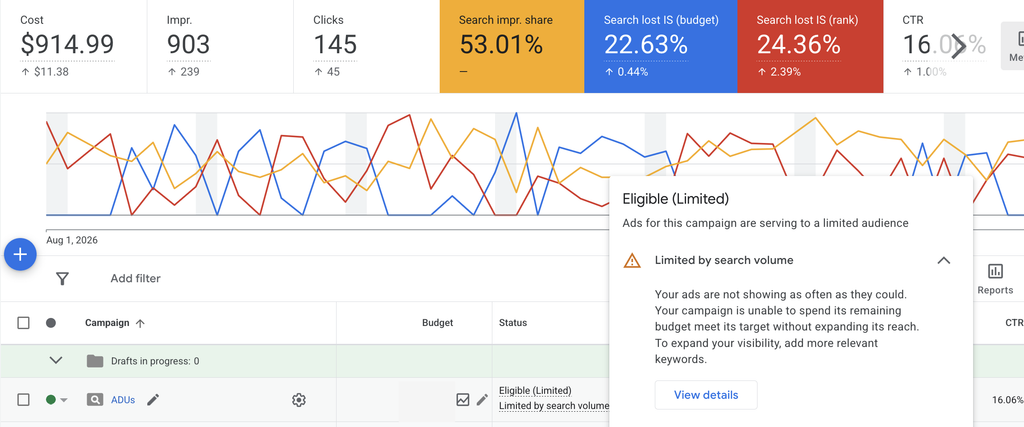
This is where looking across marketing channels became especially important. If organic traffic is declining, it’s easy to blame SEO. But paid search gives us a different view of the same market. Google Ads doesn’t require us to rank organically. We’re paying to get in front of people who are actively searching.
If plenty of people are still searching for ADU builders, but our organic visibility has declined, paid search should give us an opportunity to capture more of that demand. So we looked closely at the Google Ads account.
From August 1 through September 24, the campaign had:
- 16.03% click-through rate
- $6.22 average CPC
- 143 clicks
- 6 conversions
- Approximately 4.2% click-to-conversion rate
- Approximately $148 cost per conversion
- 52.88% search impression share
There were certainly opportunities to improve.
The campaign was losing about 22% of impression share to budget and approximately 25% to rank. That told us we could spend more and work to capture a greater percentage of the available searches. But another Google Ads signal was arguably more important: The campaign was “Limited by search volume.”
Our ads were still earning clicks at an extremely strong rate when people searched. But there weren’t an unlimited number of people searching. Now we had organic search showing reduced opportunity and paid search independently showing constrained search volume.
That changed our diagnosis.
Is your marketing underperforming, or is market demand softening?
We couldn’t attribute the client’s entire lead decline to a soft market. Doing so would ignore too many other variables.
Some lead attrition was intentional because of the geographic strategy change. Some appears connected to organic traffic loss. Some could be recovered through continued SEO investment in the long term. Referral leads had also fallen dramatically, from 15 to 2 in July, 14 to 3 in August and 13 to zero in September compared with the prior year. And recent lead quality deserved additional investigation.
But once we accounted for those factors, something else remained important: both paid and organic search were independently showing signals consistent with constrained demand.
That’s a fundamentally different marketing problem.
If you’re failing to capture existing demand, you improve demand capture. If there isn’t enough existing demand, eventually you have to create more demand.
Demand capture vs. demand generation for construction companies
This distinction actually takes us all the way back to the strategy we used when launching this business.
When the client originally came to us, a national ADU franchise was heavily promoting Meta Ads as the marketing channel franchisees should invest in.
We recommended something different. We deliberately didn’t prioritize Meta Ads.
Why? Because this was a brand-new business with a limited marketing budget.
Meta Ads can be excellent for reaching people before they’re actively searching for your service. But someone scrolling Instagram isn’t necessarily looking for an ADU builder right now. Someone Googling “ADU builder near me” is.
So we focused the client’s initial investment on demand capture: Google Ads captured homeowners actively searching for an ADU builder. SEO built the company’s ability to capture those searches organically over the long term.
The strategy helped take the company from zero to more than $1 million in signed business in its first year. But marketing strategy shouldn’t be static. The strategy that makes sense when there’s substantial existing demand doesn’t necessarily make sense when that demand softens.
When there’s less demand to capture, you need to create demand
Today, we’re recommending something we specifically chose not to prioritize when the business launched: Meta Ads. That’s not because we changed our minds about Meta. The conditions changed.
We’re still investing in demand capture. We’re increasing Google Ads spend to try to capture more of the available high-intent searches, even knowing the campaign may not be able to spend the entire budget because search volume is limited.
We’re also continuing to evaluate organic visibility and opportunities to strengthen SEO. But there’s a ceiling to demand capture. You can’t capture a search that never happens. So we’re adding demand generation to the strategy.
Instead of waiting for homeowners to decide they want an ADU and then search for a builder, we can reach potential customers earlier and introduce them to the opportunity.
That could mean content and advertising around questions like:
- Could an ADU generate rental income on your property?
- What can you legally build on your lot?
- How much does an ADU cost?
- Could an ADU create space for aging parents or adult children?
- Would converting your garage be more affordable than building a detached ADU?
The goal isn’t necessarily to make someone request a construction consultation the first time they see an ad.
We’re testing that.
But if direct consultation offers don’t generate enough qualified opportunities, we can move further up the funnel with an ADU planning guide, educational resource or in-person seminar and then nurture those prospects toward a consultation.
Our initial recommendation is a $1,000-per-month Meta Ads test alongside the increased Google Ads investment.

Good construction marketing isn’t loyal to a channel
There’s an important lesson here for general contractors and home builders. When this business launched, we recommended not prioritizing Meta Ads. Today, we’re recommending Meta Ads.
Same company. Same agency. Different strategy.
Because good marketing strategy isn’t about being loyal to SEO, Google Ads, Meta Ads or any other channel. It’s about responding to the business and market conditions in front of you.
That’s also why a channel shouldn’t be labeled “good” or “bad” based solely on whether it generated leads last month. SEO can be working while search demand declines. Google Ads can be well optimized while running out of qualified searches to capture.
Meta Ads can generate a lower percentage of immediately sales-ready leads while still playing an essential role in creating the demand your bottom-of-funnel channels eventually capture.
You have to understand the job each channel is doing.
What construction companies should investigate when leads decline
If you’re a general contractor or home builder experiencing declining leads, don’t start by asking: “Which marketing channel should we change?”
Start by asking: “Why are leads declining?”
We generally want to understand several things before making a major strategic change.
- Has the business changed? Look at service areas, services offered, project minimums, ideal customer profiles and other strategic decisions. A decline in leads you no longer want isn’t necessarily a problem.
- Has visibility changed? Look at organic rankings, impressions, paid impression share, traffic and referral sources.
- Has available demand changed? Search impressions, search volume, paid campaign limitations and trends across multiple acquisition channels can help identify whether fewer people are actively looking.
- Has conversion performance changed? Traffic can remain stable while form submissions, phone calls or booked meetings decline.
- Has lead quality changed? More leads aren’t valuable if a larger percentage can’t afford the service, aren’t located in your market or don’t meet basic project qualifications.
- Has attribution changed? Before drawing conclusions, make sure your CRM, analytics and advertising platforms are actually recording leads consistently.
- Has search behavior changed? Website traffic is no longer the only measure of search visibility. Buyers can discover and research companies through Google search features, AI assistants and other platforms without following the same path they did several years ago.
Only after answering those questions can you start deciding what to do next.
Sometimes fewer construction leads don’t mean a weaker business
There’s one more important part of this case study. Despite generating fewer leads, this client is still growing year over year and completing more projects.
That’s why lead volume should never be evaluated in isolation. Ultimately, a construction company’s goal isn’t to generate the largest possible number of form submissions. It’s to generate enough of the right opportunities to support profitable growth.
A company could theoretically generate fewer leads while winning more work because its reputation has strengthened, sales conversion has improved, projects have gotten larger, referrals have improved in quality or its ideal customer has become more clearly defined.
Conversely, a company could generate record lead volume while its actual business performance deteriorates. Marketing metrics matter. But they only matter in the context of the business outcomes they’re supposed to create.
The lesson: diagnose before you prescribe
When we launched this ADU builder, capturing existing demand was the right strategy. It helped build a company from zero to more than $1 million in signed business in its first year.
Several years later, the company is larger and still growing—but the market and marketing environment around it have changed. Some of the decline we’re seeing today is the result of intentional business decisions. Some is organic attrition. Some may reflect changes in how people use traditional search and AI. Some comes from other channels, including referrals.
And the data also gives us meaningful evidence that demand in the client’s niche has softened. That last piece changes what we do next. We’ll continue improving SEO. We’ll continue optimizing Google Ads. We’ll try to capture more of the demand that exists.
But we’ll also start investing further up the funnel so we’re not entirely dependent on people who are already searching.
Because sometimes the answer to declining construction leads isn’t simply more lead generation.
It’s understanding where the leads went in the first place, then building a strategy around what the data tells you. If you’re wondering what’s behind a slowdown in your own leads, let’s take a closer look together. The Nover team can help you make sense of what’s happening and what to do next.
